

I
"I can tell you that for sure it's more
hanks to the relentless
problems than in the years that I had in
persistence of his wife,
7– prison," he says. "In prison, you are en-
Avital, Natan Sharansky
joying not making any compromises. You
spent more than a decade
say 'no' to the KGB and you fulfill all your atop the conscience of the West,
values. [In politics] it's the absolute oppo- despite his languishing in the
site. You have to find the border of where notorious Soviet prisons.
you can compromise and where you can't."
In freedom, the former math-
Mr. Sharansky, Israel's minister of in- ematician has continued to fight
dustry and trade, was in the United States on behalf of human. rights — re-
this month, a guest of the American-Israel cently, and against the wishes
Chamber of Commerce. In an interview, of Israel's foreign ministry, in
he discussed what happens when a liv- China. Regarding the Pales-
ing legend descends into politics.
tinians, he said that he favors a
"People said that by going into politics, slow, well-defined and method-
it will be the end of me as a living symbol," ical peace process.
Mr. Sharansky says. "I said, 'I know this,
One year ago, 11 years after
but what do I need this symbol for?' Do I triumphantly arriving in
need it for the wardrobe when everyone Jerusalem after an East-West
applauds you or to use this capital to go
out to influence what everyone wants?"
Such weakening of public adulation may
"In prison you are
be inevitable when a moral hero steps into
7– the political sphere. Images of Nelson Man-
enjoying not making
dela, Vaclav Havel and Lech Walesa come
to mind.
"That's the price that I knew I would
any compromises.
have to pay and it's not something that
concerns me," he says. "The real problem
[In politics] it's the
is how to know [if] you are right. That's the
constant challenge."
A
`–)
absolute opposite."
series of scandals — including a
breaking one in which his party is
— Natan Sharansky
accused of taking $100,000 from an
alleged Russian mafioso — has sud-
denly made Mr. Sharansky, the politician,
very human to American Jews, a group
that once uniformly adored the 5-foot-4-
inch former dissident.
The change also is in part because Mr.
Sharansky is chairman of Prime Minister
Binyamin Netanyahu's dommittee on di-
aspora relations. As such, he's the gov-
ernment's point man in dealing with
American Jews on the Knesset's con-
tentious conversion bill. The bill would dis-
qualify conversions in Israel not performed
by Orthodox rabbis and it has much of
American Jewish leadership — at least
three-quarters of whom are not Orthodox
— up in arms.
Mr. Sharansky is now defending his
government to those who once fought for
his freedom. His American opponents
claim that he, of all people, should under-
stand what they see as a potential blow to
religious freedom.
As Mr. Sharansky toured the United
States, he often used his sharp wit to de-
fend his government on the conversion is-
sue. One foreign ministry official suggested
that Mr. Sharansky was really sent by Mr.
Netanyahu to cool the tempers of Ameri-
can Jews.
That Mr. Sharansky is being heard not
only in the United States but back home is
evinced by a recent decision by Israel's chief
Sephardi rabbi, Eliyahu Bakshi Doron. At
Mr. Sharansky's prompting, Rabbi Doron
told cemetery directors to allow burial of
Jewish and gentile spouses side-by-side.
(Until recently, gentiles could not be buried prisoner exchange, Mr. Sharansky's myth-
next to Jews in Israel. About one-third of ical-like life took yet another remarkable
Russian immigrants are not Jews, accord- turn.
ing to Israel's ministry of absorption.)
On May 29 1996, his fledgling political
party, Yisrael B'aliyah, received seven
Neil Rubin is editor of our sister paper,
mandates in Israel's 120-seat parliament.
The Atlanta Jewish Times.
Suddenly, he and six colleagues — who
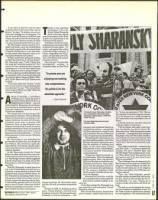
Pressing the cause: Sharansky's freedom
was a central tenet in the Soviet Jewry
movement. Pictured above, a 1978 rally
in New York City.
Free man: Sharansky arrives in Israel
in January 1986.
had spent their adulthood bitterly op-
posing Soviet policies — were pivotal
coalition partners for Israel's next
prime minister. Not one of them had
a day of experience in elected office.
Recognizing Mr. Sharansky's role
as a key coalition partner, new Prime
Minister Binyamin. Netanyahu gave
him the ministry of industry and
trade. At the same time, Yisrael
B'aliyah's No. 2 man, Yuli Edelstein,
was named minister of absorption
and immigration.
Things were relatively smooth un-
til mid-October. Then the Sephardi
religious party, Shas, introduced a
bill in the Knesset to invalidate non-
Orthodox conversions. Shas said it
had to halt the advances of non-Or-
thodox movements through decisions
by the country's Supreme Court,
which actually had deferred the mat-
ter to the Knesset.
Netanyahu's Likud bloc voted for
the conversion bill, which passed the
first of three needed readings to be-
come law.
On the first reading, Mr. Sharansky was
non-committal and instructed Yisrael
B'aliyah to abstain.
Why? David Ben-Gurion, Israel's first
prime minister, crafted what's known as
the status quo agreement," Mr. Sharan-
sky explains. It said that anyone convert-
ed in the diaspora by a rabbi accepted in
that community was considered a Jew in
Israel.
In Israel, however, only the actions of
Orthodox rabbis would count.
"I felt in Russia, and today, that every-
one who feels he is a Jew is a Jew," Mr.
Sharansky says. "After thousands of years
of pogroms ... if people feel they belong to
this people, why not? The notion is that Is-
rael belongs not [only to] everyone who
lives in Israel, but to all the Jews in the
world. But it has serious practical impli-
cations.
"If you take my formula — everyone who
says he's a Jew — you have to grant citi-
zenship. We have 100,000 legal and
100,000 illegal Thai and Rumanian work-
ers. What about them? It's extreme, but
you have to say it. So you have to say,
`What is converted? "
"The challenge from the beginning for
Ben-Gurion was to make one nation that
accepts it." Yisrael B'aliyah, he adds, ac-
tually blocked attempts by the religious
parties to invalidate non-Orthodox con-
versions abroad.
"Then the ultra-Orthodox parties
brought another proposal that had the sta-
tus quo, which is bad actually for the ul-
tra-Orthodox," he says. "People go to
London and get conversions and this is not
good.
"We said we are for keeping the status
quo, but putting it in legislation is bad. Ifs
evil. First we have to [make] every attempt
to avoid legislation. We insisted that [the