
A Plan At Last
Israel's prime minister unveils his long-awaited "final status agreement" with the Palestinians.
or the first time since this
government took office, we
have clarified — to our-
selves, and to the Pales-
tinians — our guidelines for a
final status arrangement," said
Justice Minister Tsachi Haneg-
bi.
He was referring to the guide-
lines laid out recently by Prime
Minister Binyamin Netanyahu.
They amount to a rough scheme
known in the Israeli political lex-
icon as "Allon-Plus."
The Allon plan was a program
for territorial compromise pro-
posed shortly after the 1967 Six-
Day War by the late military and
Labor Party hero Yigal Allon.
The "plus" in the updated version
is that Israel would keep more
land in the West Bank than Mr.
Allon envisaged.
Mr. Netanyahu did not draw
any maps. But he did lay down
conditions that would give Israel
about 50-60 percent of the West
Bank. It is understood that this
would be an opening position in
the final status talks with the
Palestinians; no one can say how
flexible or inflexible Netanyahu
would be as the talks progressed.
Under Mr. Netanyahu's plan,
Israel would keep the Jordan Val-
ley — a swath of land running
down the West Bank along the
border with Jordan. It would also
keep the area around Jerusalem
and close to the Green Line,
where most of the West Bank set-
tlers live. In addition, Israel
would hold onto land where the
West Bank's underground water
sources lie, and maintain control
of the major roads running
through the territory.
Mr. Netanyahu did not say he
would uproot Jewish settlements,
but he did come out in favor of
"settlement blocs." This implies
that at least some of the settle-
ments isolated in overwhelmingly
Palestinian areas would come
under Palestinian control, effec-
tively forcing the Jews living in
those settlements to relocate.
Under Mr. Netanyahu's plan,
the Palestinians would get much
of the interior of the West Bank,
but their land would be broken
up by pockets of Israeli-controlled
territory. Presumably, the Gaza
Strip would remain as it is — un-
der Palestinian rule, except for
the Gush Katif strip of Jewish
settlements adjacent to Israel
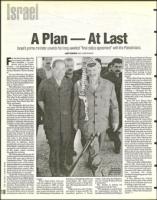
PHOTO BY AP/ADEL HANA
LARRY DERFNER ISRAEL CORRESPONDENT
DETROIT JEWISH NEWS
F
118
proper.
When Yigal Allon came up
with the original, more concilia-
tory proposal in 1967, he had
Jordan in mind as a partner. Jor-
dan would take over the land Is-
rael would relinquish, and rule
the Palestinians living there. At
that time, a Palestinian state was
unthinkable. Mr. Allon later
broached his plan to King Hus-
sein. The king dismissed it com-
pletely.
Today, however, the "Jordan-
ian option" is gone and Mr. Ne-
tanyahu's partner is Yassir
Arafat. And today the Palestini-
ans are writing off Allon-Plus as
a nonstarter.
Mr. Arafat is letting his
mouthpieces talk for him.
"This program is a good basis
for negotiations between Ne-
tanyahu and [National Religious
Party Knesset Member] Hanan
Porat and the settlers, but not for
negotiations with the Palestini-
ans," said Arafat adviser Ahmed
Tibi. "At this rate, Netanyahu's
next proposal will be to allow the
Palestinians to breathe fresh air
without [first having to pass
through] Israeli-army check-
points."
While Allon-Plus has already
reached what may be a dead-end
with the Palestinians, it appears
to have strengthened Netanyahu
at home. The plan has won wide
support within Mr. Netanyahu's
coalition — although the Na-
tional Religious Party has ob-
jected to giving over any Jewish
settlement land to the Palestin-
ian Authority.
Even Tel Aviv Mayor Roni
Milo, a frequent critic of Mr. Ne-
tanyahu who defines the left edge
of the Likud, said, "'Me prime
minister should be congratulated
on this proposal. It is a good place
to start, and the Palestinians
would do well to agree to re-enter
the negotiations on this basis."
While Israeli left-wing critics
derided the plan as terminally
unacceptable to the Palestinians,
the opposition Labor Party was
fairly tongue-tied, and for good
reason: Its newly-elected leader,
Ehud Barak, has gone on record
as saying that, he, too, favored
a version of Allon-Plus. It was
widely noted that Netanyahu
outlined his plan on the day af-
ter Mr. Barak won the Labor pri-
mary and that nobody believed
the timing was coincidental.
Ha'aretz political correspon-
dent Yossi Verter wrote that Mr.
Netanyahu's proposal was aimed
firstly and lastly at Mr. Barak—
to spoil the new Labor leader's
strategy of luring centrist Israeli
voters away from him.
There were other political ben-
efits for Mr. Netanyahu in his
plan: It laid down a strong basis
for a future national unity gov-
ernment with Labor, and, there-
fore, increased the prime
minister's bargaining power with
his right-wing.
It also showed the United
States and the rest of the world
that he is not a Shamir-clone, but
is willing to give an inch.
And the plan went a long way
toward answering the nagging
question, "What does Netanyahu
want?" ❑
Scanned image of the page. Keyboard directions: use + to zoom in, - to zoom out, arrow keys to pan inside the viewer.
June 13, 1997 - Image 126
- Resource type:
- Text
- Publication:
- The Detroit Jewish News, 1997-06-13
Disclaimer: Computer generated plain text may have errors. Read more about this.