
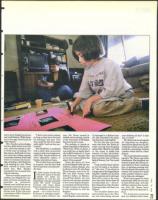

learn about English grammar
and world history. While bring-
ing in the eggs, they'll pick up
some science.
Mrs. Kander acknowledges
that her skills lean toward the
arts, while her talents in oth-
er fields may be lacking. For
this reason, she'll seek out sup-
port when her children express
a particular interest. Hone child
wants to increase his knowl-
edge of biology, she'll find him
a job helping in a lab. When
Beth wanted to learn more
about law, Mrs. Kander
arranged for her to spend time
with an attorney.
There are certain projects the
children are obligated to com-
plete, but these are hardly rec-
ognizable as homework.
Instead, each child has the op-
portunity to proceed at her own
speed, focusing on what inter-
ests her most. In fact, this is the
cornerstone of Mrs. Kander's
entire philosophy.
"I don't worry about content,
as long as they have the tools
for learning," she says. "Can
they read? Do they have basic
math skills? And are they mo-
tivated?"
This flexibility is combined
with a daily dose of parental
support and encouragement,
which Mrs. Kander believes is
what ultimately makes, or
breaks, education at home.
"It's not that home schooling
is so great, but the fact that
there's parental commitment,"
she says.
I
t didn't matter whether she
was prom queen or the girl
nobody ever asked out,
whether he was the star
quarterback or the guy everybody
called "Mr. Nerd." Virtually
everyone with whom Diane
Baum has spoken loathed school.
"I've talked to many, many
people — all of whom had un-
fortunate or unhappy experi-
ences in public schools," she
says. Ms. Baum herself at-
tended various schools, and lat-
er the University of Michigan,
but found it all a waste.
The problem is, people at-
tribute culpability to themselves.
"They'll say, 'Well, you know, I
was really shy, so maybe that's
why it didn't work out,' or, 'I was
sick all the time," she says. "But
no one ever wants to blame the
school. It's too sacred."
Today, Ms. Baum; 47, lives
in Grand Rapids with her two
children, Joshua Ahsoak, who
is about to turn 18, and Anna
Flora Somers, soon to be 10.
She has little contact with
Joshua's father, an Eskimo.
Anna Flora's father, who was
t Jewish and a former member
of the Grand Rapids Sympho-
ny, has since moved out of town,
though he helps out financial-
ly and continues to visit his
daughter.
Diane Baum was raised in
Grand Rapids, where her fam-
ily belonged to a Reform tem- your children all day?' Is that
ple. She attended U-M, study- sad, or what?"
ing literature and English.
Ms. Baum has no set agenda
By the time she was preg- for educating her daughter.
nant with Josh, Ms. Baum al- Anna Flora spends her day fol-
ready was long wary of popular lowing her mother as she works
notions like, "Read to your child caring for a paraplegic, helping
in the womb to make him a senior citizen and in a laun-
smarter." In fact, she had be- dromat.
gun to believe that many prob-
"It's a real education just be-
lems in society stem not from a ing here," Ms. Baum says of the
lack of literacy, but "too much laundromat. Her daughter has
of it."
learned a great deal about hu-
"I call myself a home schOol- man behavior from watching
er, but I'm really a 'no-school- how, in-between pouring cup-
er,"' she says. "I see school as fuls of suds into the washer, one
a large part of the degradation woman will smack her small
of society. Children are at school child, another will give a quar-
all day, parents can't wait to get ter to help out a stranger.
them off to camp in the sum-
What most regard as basic
mer, then they dump them off educational skills are not part
to a baby sitter, too — all to re- of Anna Flora's day. At 9, she
lieve themselves of the 'burden' still does not know how to read,
of having to deal with their own nor does Ms. Baum know
children.
whether she'll ever teach her to
"You wouldn't believe how do so.
many parents say to me, 'How
"I'm much more concerned
can you stand being around that my children learn basic