

The Kanders are among a
handful of Jewish families in
Michigan who home school
their children, and one of the
few to discuss it openly. "We
don't like to talk about it pub-
licly because, you know, of the
ramifications," said one moth-
er, whose husband teaches
their children. The unspoken
concern: They don't want to be
thought of as oddballs.
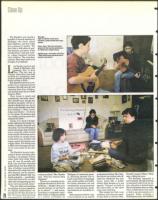
This page:
Right: In addition to their home
schooling, Jacob and Beth take music
classes.
Below: Adam, Beth and Lisa Kander
prepare for their very hip performance
of A Midsummer Night's Dream.
Opposite page: Lisa Kander with Claire:
"What makes home schooling work is
parental commitment."
DETRO IT JE WIS H NE W S
L
78
isa Kander was born and
raised in Michigan. Her
husband, Ken, is from
Ohio. The two met in
Chicago, where they were both
working at a restaurant, then
lived in a number of rural areas,
finally settling in Holly.
Ken Kander serves as a con-
troller for a communications
business. His wife cares for and
educates their four children,
and teaches part-time at Beth
Israel in Flint.
Their house is small and
unassuming, "not really a farm"
Mrs. Kander says; though city
dwellers certainly will be in-
clined to think that way. In ad-
dition to the Kanders and their
four children — Beth, Jacob,
Adam and Claire — it's home
to "two goats, 10 chickens and
two roosters, and one goose that
adopted the flock."
Inside, it's a kind of hodge-
podge reflecting the family's in-
thrests: Judaism, farm life and
education. On one wall hangs a
picture showing a Star of David
and a menorah, while Jewish
books tumble off shelves and in
boxes beside an upright piano
in the front room. Another wall
bears a poster discussing ways
to fight rabies. The dining room
is filled with drawings and oth-
er art work made by the chil-
dren.
The Kanders became inter-
ested in home schooling after
reading a newspaper article
when their first child, Beth,
now 15, was 18 months old.
Both Lisa and Ken attended
public school, but they liked the
idea of taking responsibility
themselves for what their chil-
dren learned, and for preserv-
ing what Mrs. Kander calls "our
family integrity — specifically,
what that meant for our chil-
dren who were growing up Jew-
ish in very non-Jewish areas."
The two believed teaching
the children at home helped fos-
ter "family cohesiveness," es-
pecially for the first 10 years of
life. Of course, Beth has long
since passed 10, "and she's nev-
er been to school," Mrs. Kande/-
says. "But the reasons keep
changing."
There is no mandatory for-
malized education in the Unit-
ed States — despite what your
parents told you, no one "has to
go to school," — and home-
schooling is completely legal.
Most states do obligate parents
to a certain curriculum (in
Michigan, it's extremely gener-
al, directing parents only to
teach some form of language
arts, social studies and math),
but home educators are not
monitored by any government
agency. Consequently, teach-
ing methods are decidedly di-
verse.
Some parents enforce a rig-
orous program in an almost
professional setting. Mrs. Kan-
der knows one woman who di-
vides her childrens' day into
hours, much like a public
school, then focuses on a set
agenda. "Classes" are held at
the same table, in the same
room, each week day.
"She makes her kids wear
uniforms, and when she teach-
es they have to call her 'Mrs.
[Smith]' instead of Mom," Beth
says, rolling her eyes.
The Kanders' approach is
more relaxed. Though learning
to read and write is not an op-
tion, education is treated more
like an adventure than an oblig-
ation. A daily lesson may mean
a visit to an art museum or a
hospital. While studying a
Shakespeare play, the children