

ROSII0Ct
After a turbulent start, Israel's leader is slowly
growing in stature, let alone experience.
INA FRIEDMAN ISRAEL CORRESPONDENT
of' (though not commit itself to) the under- and his own regime.
standings reached between the two parties
If the basic emphasis of an Israeli-Syri-
in their earlier negotiations, the Syrians an agreement were changed, and Assad
will have less difficulty returning to the bar- were relieved of these perceived "threats,"
gaining table.
he might be more willing to meet even the
The second, put forward by the European most stringent Israeli security demands.
Union envoy, is to trade the term "land for And if Israel's most stringent security de-
peace" for the formula "full withdrawal for mands were met, Mr. Netanyahu could
full security."
undergo the same sea change about a with-
This idea could have more appeal, es- drawal that Rabin did in his day.
pecially to the Syrians, than thought. Likud
Either way, Mr. Netanyahu has ample
strategists have long been arguing that Mr. reason — beyond Washington's interest in
Assad is loath to have open borders with his doing so — to extend his government's
Israel — a key element of the "full peace" negotiating efforts to the Syrian track. One
envisioned by the Rabin and Peres gov- is that even before the recent tragic heli-
ernments. He fears that it will Syrian President Assad: copter crash, the public debate
destabilize Syria's closed society
Pulling back.
over maintaining a costly mili-
tary presence in south Lebanon had begun
gathering force. As the Hezbollah grows
stronger and more daring, and as support
for its actions rise among the local Lebanese,
the issue is likely to become increasingly
onerous. And since the only road out of
Lebanon runs through Damascus, it is ob-
isly in Mr. Netanyahu's interest to reach
an accommodation with the Syrians quick-
ly.
Yet, even if that proves to be a long and
wearisome process, Mr. Netanyahu enjoys
an enormous advantage over his adversary
in the critical arena of public opinion. Short
of precipitating a war, Mr. Assad has nei-
ther Mr. Netanyahu's media savvy nor the
potential to rally the Arab world behind him
in the way that Mr. Arafat did after the
Hasmonean Tunnel opening and subse-
quent violence in September.
Also, Mr. Netanyahu can and has argued
that Mr. Assad balked at reconciliation and
shunned even the Labor leaders who of-
fered him (even if only obliquely) a full with-
drawal from the Golan.O
AP/MARCY NIGHSWANDER
aving finally paid his dues, so to
speak, and after completing the
long overdue redeployment in He-
bron, Prime Minister Binyamin
Netanyahu arrived in Washing-
ton recently to accept kudos.
Having met with Palestinian Authori-
ty Chairman Yassir Arafat, he reported on
the plans to carry out the first of three "fur-
ther redeployments" at the beginning of
March and to resume the key negotiations
on the permanent settlement with the
Palestinians. Still, the bulk of the Wash-
ington talks were slated to be about getting
the negotiations with Syria going again.
The crux of this effort has been the search
for a formula that will enable Israel and
Syria to sit down again without either side
losing face.
Since last summer, the two sides have
communicated mostly through the press
and over the airwaves in a rigid code. The
Syrians have insisted that the peace talks
be resumed from where they left off a year
ago. Recently, however, in a session with a
European Union special envoy, Syria's Pres-
ident Hafez el-Assad pulled back from that
position (which would effectively require
the Netanyahu government to embrace the
policies of its Labor predecessors). While
this is hardly a cosmic leap, Mr. Assad's
statement did leave the window open to fur-
ther (particularly American) mediation.
Israel also has moved from its original
stipulation that the talks be resumed "with-
out any preconditions." The new formula,
proposed by Foreign Minister David Levy,
is that the talks be based on the under-
standing that brought on the 1991 Madrid
Conference: the mutual acceptance of Se-
curity Council Resolutions 242 and 338 —
the latter being widely translated into the
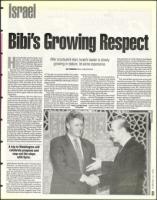
A trip to Washington will
celebrate progress and
map out the steps
with Syria.
catch phrase land for peace." It stops short,
however, of determining what (or how
much) land for what (or how much) peace.
Mr. Netanyahu has repeatedly stated
that his government has its own views on
that matter. Aware of that qualification,
Mr. Assad told Moratinos that before warm-
ing up to Mr. Levy's suggestion, he wants
to know just what those views are.
Meanwhile, two other proposals have
been tossed into the diplomatic cauldron.
One, actively promoted by former Israeli
foreign minister and now Labor Knesset
member Ehud Barak, suggests that if the
Netanyahu government agrees to "take note
N..
FEBRUARY
a,
81
t
1