

An indelicate
solution to Jewish
and Arab claims
of a Jerusalem
garbage dump
could spark
violence like that
around the
Temple Mount
tunnel.
INA FRIEDMAN
ISRAEL CORRESPONDENT
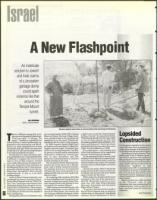
Seminary students erect a fence on land near Hebron that may belong to Palestinians.
LJJ
uJ
CD
CC
UJ
LLJ
66
.,. here's a Hebrew saying that is cit-
ed ever more frequently these days.
"Don't be right," it advises, "be
smart." Created as a guideline for
Israeli drivers, it seems particularly ap-
propriate to the controversy over Ras el-
Amud, an Arab neighborhood of east
Jerusalem that last week was approved
as the site of a 132-unit housing complex
to be built specifically for Jews.
On the face of it, many Western read-
ers (and Israelis, too), would probably find
it difficult to imagine why Jews would
want to live in Ras el-Amud. Tucked
away south of the narrow Jerusalem-Jeri-
cho road, at the foot of the cemetery on
the Mount of Olives, the 3.7-acre area ap-
proved for Jewish housing is not only iso-
lated from Jerusalem's other Jewish
neighborhoods, it also is a de facto
garbage dump.
Land in Ras el-Amud originally was
purchased by Jews in the last century,
by the "Kolel Chabad" and the "Kolel Vol-
hyn," two communal associations that
channeled charity from abroad to the in-
digent Jews of Jerusalem. They simply
wanted to extend the ancient cemetery
on the Mount of Olives for the benefit of
their constituents.
During the period of Jordanian rule
over east Jerusalem (1948-1967), Ahmed
Hasin el-Ghoul, the local village head-
man, planted wheat on the property and
registered it in his name. Ghoul's de-
scendants still lay claim to the property.
In 1984, however, Israel's High Court
of Justice confirmed that it indeed be-
longed to the two kolels. Thereafter they
sold it to Dr. Irving Moskowitz, the Mia-
mi patron of Israeli settler associations
dedicated to "redeeming" Jewish prop-
erty in east Jerusalem, and Mr.
Moskowitz submitted plans to construct
Jewish housing on his land.
The Jerusalem District Planning Com-
mission sat on the matter for a decade.
Last week it finally issued its decision.
The garbage dump is to be turned into
132 units for Jews, while permits for an
additional 560 units are to be made avail-
able for Arabs.
At a meeting with members of the Ras
el-Amud Neighborhood Association last
recently, Palestinian leader Feisal Hus-
seini charged Israel with plotting to turn
Jerusalem into another Hebron.
"After having surrounded the city with
Jewish settlements, to cut it off from the
rest of the West Bank, the Israelis are
now trying to infiltrate the heart of Arab
Jerusalem," he complained. "If Jews have
a right to live on Jewish-owned property
in Ras el-Amud," he argued pointedly,
"Palestinians should have the same right
to live on their property in [the west
Jerusalem neighborhoods of] Baka'a, Tal-
biyeh and Katamon" which have been
populated solely by Jews since they came
under Israeli juri§diction in 1948.
Ws a cogent point — and certainly part
of the final settlement to be negotiated
between Palestinians and Israelis.
In the planning for Ras el-Amud, Arab
residents will be allowed to exploit 50 per-
cent of the area allotted them, while the
Jewish builders can exploit 115 percent
of theirs (thus building higher and more
densely).
All told, the Arabs of Ras el-Amud are
being allotted 6,200 square meters for
dwellings and services; the Jews 16,500
square meters for the same.
What makes the situation all the more
unseemly in the eyes of its opponents is
that Mr. Moskowitz is known to have
close ties with both Prime Minister
Binyamin Netanyahu and Jerusalem
Mayor Ehud Olmert.
"It appears that how land is used in
Ras el-Amud depends less on objective
criteria than on who owns it," says Israeli
attorney Daniel Seidemann of the Ir
Construction statistics in Jerusalem
since 1967 have been so lopsided as to
make other charges of discrimination
in the Ras el-Amud case hard to ignore.
According to Israeli attorney Daniel
Seidemann of the Ir Shalem Associa-
tion (which, together with residents of
Ras el-Amud, is contesting the legali-
ty of the Planning Commission's deci-
sion), 8,800 units have been built for
Palestinian residents in east
Jerusalem since 1967, to accommodate
a population increase of 100,000 peo-
ple; whereas more than 64,000 units
have been built for Israelis, for an in-
creased population of 205,000 over the
same period.
Seen in another way, fully one-third
of the 70-sq.-km. area of east
Jerusalem has been expropriated for
Israeli housing, while a mere 6.5 sq.
kms. has been zoned for Arab con-
struction.
— Ina Friedman