

iSSMAWASid6
? '
S5W2SSOMIOMMOMMMISSaSZ4V,
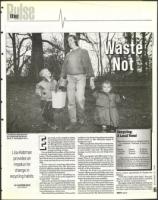
Lisa Katzman walks back from
her compost pile with her son
Daniel, 3, and daughter Tess, 1.
Lisa Katzman
provides an
impetus for
change in
recycling habits.
JILL DAVIDSON SKLAR
STAFF WRITER
AMVAZINA.".ZSOW
ach week, as her neighbors schlep
several bags, boxes and cans teem-
ing with garbage to their curbs as
an offering for the sanitation work-
ers, Lisa Katzman makes her way
down her steep driveway toting her
meager half-bag of trash.
It is not that she lives alone or that she has
a special relationship with a garbage com-
pactor. The Bloomfield Hills mother of two
and wife of one is on a personal crusade to re-
duce, reuse and recycle as much trash as pos-
sible.
As the owner of a recycling information
business called Waste Not, Ms. Katz man
hopes to influence people who are already on
the path of changing their personal habits to
make for a better environment.
"Every time I go to throw something out,
I ask myself, 'What is the earth supposed to
do with this?' " she said.
That is the question she began asking her-
self years ago. As a registered dietitian work-
ing on research at the University of Toronto,
her environmentally aware colleagues began
making her more conscious of the waste she
was producing on a daily basis.
Also alarmed by predictions of the earth's
" ,XPAKffNMAMST
OMOMMIrabeW
OK*MWASW.M.P
condition in the future if recycling and reusing
doesn't catch on, Ms. Katzman began to
change her ways.
"When people hear about the environment,
it is in a very scary way: that the rain forests
are being slashed, that my children will have
to wear masks," she said. "By doing these
changes in your home, you are doing some-
thing."
First, newspapers and office paper were a
target. Then it was plastics and glass, fol-
lowed by batteries. Eventually, as she con-
verted to the environmental movement, she
stopped buying individually packaged items
and started to focus more on those marked
with #1 or #2 on the bottom.
Although she lived in an apartment in
Toronto where recycling facilities were non-
existent, Ms. Katzman dragged her bounty
to a local radio station several blocks away
where recycling bins were available.
Ms. Katzman started her business two
years after moving to Bloomfield Hills from
Toronto with her husband, former Canadian
Olympic rower and current Sinai urologist
Jim Relle. Relocating from an apartment to
a home at the same time as she became a
stay-at-home parent, Ms. Katzman found she
AW4VM.,74,2WW,M=OZWAVAMWON
aLMS'NiriSS",,,';',':00
cal Trend
had a unique opportunity to change her
lifestyle.
"I felt like I had a clean slate," she said.
"Here, we had this home and we could do
what we wanted. I could start fresh."
She began using cloth diapers, soaking and
washing them in a washer and letting them
line dry in the basement to save on energy;
she kept a pail by the kitchen sink to collect .
WASTE page 66