

PHOTO BY DANIEL LIPPITT
Shemi
In The
Abstract
MEP
An interview with the world-renowned
Israeli artist.
SUZANNE CHESSLER SPECIAL TO THE JEWISH NEWS
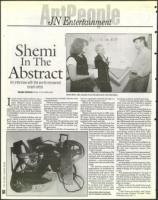
Calman Shemi, right, discusses his art with patrons at the Park West Gallery.
I
THE DETR OIT J EWISH NEWS
sraeli artist Calman Shemi has a
Detroit connection for his artistic
style. Shemi's latest sculptural
forms are finished with car paint.
"I've moved into laser-cut sculpture,"
explained the artist during a recent ex-
hibit of his work at the Park West Gallery
in Southfield, where he continues to be
represented.
"I cut pieces of steel and then use car
paint, which is best to apply to metal.
Each type of material needs a special
paint, just like oil is best on canvas."
Most of what Shemi creates is abstract
with rich, vibrant colors. For his figura-
tive pieces, he generally turns to nature
94
— human forms, animals, flowers, trees
and landscapes.
`There is a happy element of optimism
in my work because I try to take people
from an ordinary life to a spiritual life,"
said Sherri, who wants his images to pro-
vide a distraction from problems.
"The length of life doesn't go up; it goes
down. Every day, we come to feel older,
and every day, we collect deceptions and
bad experiences.
"I'm sure that 10 years from now I will
be sick. I don't know which sickness I will
have, but it will mean, in another way,
life goes down.
"Because of all this, it's necessary to
have an optimistic attitude through an
escape, and the escape is art."
Sherri, 57, was born in Argentina and
graduated from the School of Sculpture
and Ceramics in Mendoza. He was a stu-
dent of the Italian-Argentinean sculptor
Libero
Shemi moved to Israel in 1961, join-
ing Kibbutz Carmia, where he stayed for
20 years before making his home in
Jerusalem. Besides working the land, he
sculpted with wood and clay.
"I've always been a Zionist, but I've
never been religious," the painter/sculp-
tor said about moving to Israel. "I was
sure that the Jewish people had to have
their own country. I also was
sure that the way to build this
country was through agricul-
ture."
Much of Shemi's career has
been devoted to what he calls
"soft paintings," made from a
technique he developed using
thousands of pieces of felt and
woolen threads.
Through the technique, the
use of brushes and pencils is
replaced with the application
of materials to create distinct
textures — rich and strong in
content and color yet soft to the
touch.
The process requires the
preparation of hundreds of
rolls of materials of various
thicknesses and colors. The
materials are hand-cut and
layered using applique meth-
ods that transform a base
painting into a new medium.
"I discovered that technique
by accident, but I stopped .be-
cause I'm bored with it," said
.Shemi, who was unsuccessful
Calman Shemi: Blue Fire Dance,
laser-cut sculpture, painted metal.
in trying to get his method patented.
"I went to soft paintings after working
with wood and clay. I turned to regular
painting next and then went back to
sculpture, mostly ceramic."
Shemi first claimed international at-
tention in 1977, when Israel's President
Katzir presented one of his works to
Egypt's late President Anwar Sadat dur-
- ing Sadat's historical visit to Jerusalem.
Shimon Peres presented French Presi-
dent Mitterand with an artwork by She-
mi, whose paintings and sculpture can
be seen in public buildings and private
collections around the world.
"In the last 10 years, I've done 70 one-
man shows, many in New York," She-
mi said. "When I go to an opening of my
work, I feel very lucky to watch people
looking and even more lucky when they
buy something I have made."
Although he professes no religious al-
legiance, Shemi has created concrete
works depicting stories from the Bible.
He also has captured scenes from
Jerusalem.
"I never create art that is geometrical,"
said the father of two grown sons who
have no artistic leanings. "I keep paint-
ings of my wife and me because they have
personal value."
An important current project is plan-
ning artwork for a cruise ship. This will
be the second time the artist has been
asked to design art to appeal to voyagers
at sea.
"I'm preparing sketches," he said. "I
did original paintings for another ship,
but this will have sculpture, too. Because
of the moisture in that setting, the paint-
ings will have to be framed carefully with
glass coverings."
Shemi works in his studio from early
morning to early evening during the
week.
"I don't have any hobby, and I don't
play any type of sport," he said. "I like
working on my art." ❑