

S
imilarly, Bruce Sinofsky has a sto-
ry to tell. In June of '93, Bruce
Sinofsky noticed an article in the
New York Times. It told of three
teen-aged boys in West Memphis, Ark.,
who had been arrested for supposedly sac-
rificing to the devil three 8-year-old boys,
one of whom was genitally mutilated.
Sinofsky was intrigued. He wondered
how these three teen-agers could be so dis-
tanced from every normal emotion. He
thought the whole thing eerily resembled
a real-life River's Edge — the 1986 film
of a group of teen-agers' odd lack of con-
science in dealing with the murder of one
of their friends, by one of their friends.
When Sinofsky saw the article, it
seemed like a set case. As it turned out,
the only thing set about it was that the
three victims were, indeed, murdered.
Everything else about the case, right up
to the end, was up for speculation.
Bruce Sinofsky has the advantage of be-
ing a documentary filmmaker. He and his
partner, Joe Berlinger, under the auspices
of their production com-
Bruce Sinofsky and pany, Creative Thinking,
Joe Berlinger co-
made the 1992 Brother's
directed Paradise
Keeper, which covered
Lost: The Child
the story of Delbert
Murders at Robin
Ward, an elderly, uned-
Hood Hills.
ucated fanner in upstate
New York accused of
smothering his sickly brother.
The intrigue of the murders in West
Memphis drew the filmmakers to visit the
area and initiate research. The result is
POLICE *DEPT.
MEMPHIS, AR
POLICE DEPT.
W MEMPHIS, A
Maysles Films Inc. that Joe Berlinger met
Bruce Sinofsky.
Although it was happenstance that both
this and Brother's Keeper dealt with death
— and of an unusual nature — Sinofsky
asserts that his and Berlinger's interest is
in American subcultures.
"What attracts us to our subjects is not
the murder per se, but the people them-
selves, and exploring what this town went
through. It allows us to explore groups of
people we don't usually have the opportu-
nity to meet."
One consequence of interacting with the
subjects, not just filming them, was that
the filmmakers were beckoned from their
role of voyeur to actually play a part in the
sequence of events. The stepfather of the
castrated boy gave Douglas Cooper, the
film's cinematographer, a knife as a gift.
Realizing it had remnants of blood on
it, the filmmakers were presented with a
dilemma: "What do you do?" asked Sinof-
sky. "Do you heap more pain on this guy's
life? His son was raped and murdered. Or
do you obey civic duty and hand the knife
over to the police? We were concerned it
might shut the film down. And, we had
built this trust and bond with the people
involved."
Sinofsky and Berlinger discussed it
amongst themselves, with their attorneys
and with Home Box Office, which was pre-
senting the film. They decided to give the
knife to the authorities.
'We thought, 'Hit stops, at least we did
the right thing.' Mark [the stepfather] was
Paradise Lost: The Child Murders at Robin a little perturbed, but ultimately, his de-
Hood Hills, a documentary chronicling sire to be on film outweighed his concern
the trial of three local boys accused of the with people's opinion of him." Riming con-
murders.
tinued.
More than just a murder-trial story,
Sinofsky partially credits his parents'
though, the film objectively presents all style of child-rearing for the insight and
facets of the events: The audience sees the integrity he uses in his work. "I was raised
families of the victims maintain their cer- in a Conservative [Jewish] household. Be-
tainty of the defendants' guilt, while the ing a humanist, caring for people is how
families of the defendants maintain their my parents raised me. A lot of people live
innocence. All of this is set against the their whole lives isolating themselves, or
backdrop of a town willing to believe the not meeting people different from them-
guilt of the defendants before the trial has selves. To me, there's a beauty to all sorts
ever begun.
of faces.
"The access we achieve is
"As filmmakers and people, we are fas-
largely from the work we put cinated by the human condition. Of course,
into it," explains Sinofsky. we bring our own prejudices," Sinofsky ex-
'e don't just do a story and plains, "but so do they. We think of our-
leave; we really care about selves as these white Jewish filmmakers
the people.
from New York City, educated ... But these
'We spend time before and things we see as [advanced], they see as
after film time, getting to strange.
know the people involved,
"Essentially, I try to treat each individ-
and letting them become fa- ual as a human being, and not beyond
miliar with us, trusting us. that." E
We're not lit and run' film-
Mother Night opens today in Detroit
makers."
theaters. Ruralise Lost: The Child Mur-
Much of the pairs' film-
ders at Robirt Hood Hills is showing ex- co
making technique is a result
elusively at the DIA's Detroit Film
g;
of the influence of Albert and
Theatre: 7 and 10 p.m. Friday; 4, 7 and
David Maysles, among the
10 p.m. Satinday; 4 and 7 p.m. Sunday,
"founding fathers" of nonfic-
,r;
Nov. 15-17. Call (313) 833.-2323.
tion filmmaking and cinema
With the interest Paradise Lost has
verite, or "direct cinema," the
generated since its premiere at the co
process of filming as the sto-
Sundance Film Festival in January, „7_,
ry unfolds, rather than from
HBO has asked the filmmakers to
an historical perspective. It
revisit West Memphis to update the
was while working at
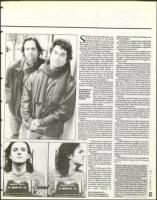
Damien Wayne Echols is
accused of murdering three 8-
year-old boys in Paradise Lost.
audience. If you can't wait that long,
visit the Paradise Lost Website at
http: 1 I www.gothamcity.co
corn 1 par-
adiselost 1
87