

SIN Entertainment
•
d
Two filmmakers explore their
cinematic visions of good and evil
and the shady grays that are rea4
T Crl CS
S Genes
ilm is, literally, a trans-
parent strip of flexible base
material. What shows up
on that strip is the oblig-
ation of the filmmakers,
and fortunately, there are
some filmmakers that do,
indeed, regard that task as
a responsibility.
Two such "responsible" artists, screen-
writer Robert Weide and director Bruce
Sinofsky, have translated to the screen a
number of questions, many effectively left
unanswered, that would boggle even
Schopenhauer or the existential Nietzsche.
That's the point.
Robert Weide's first project earned him
the designation "boy wonder." At the age
of 21, he co-wrote and produced the PBS
documentary "The Marx Brothers in a
Nutshell," receiving critical acclaim for
himself and his film.
Today, at 37, Weide has taken on the
monumental task of adapting the Kurt
Vonnegut novel Mother Night into a
screenplay. The film, which stars Nick
Nolte and Sheryl Lee, opens in Detroit to-
day.
"I was a film brat as a kid," says Weide.
"I was always interested in movies." He
discovered the Marx Brothers in junior
high, branched off into classic films and
musicals in high school, then graduated to _
the European New-Wave directors such
as Goddard and Renoir. All along though,
he loved writing, and he loved reading. Es-
pecially Kurt Vonnegut.
"I got turned on to Vonnegut in high
(/) school; he was an obsession of mine. I was
always trying to find short stories of his
•
that were not collected, [such as] from the
•
Saturday Evening Post," he explains.
cl) "Somewhere in there I read Mother Night.
I literally closed the book and said, have
•
to make a movie of this.' That was 20 years
ago."
t
Weide's first step toward realizing that
o cc
ambition was applying to the University
of Southern California Film School, by
C)
LU
w which he was promptly rejected. Three
times. So he settled for a junior college in
his hometown of Orange County, which he
an utilized for its production equipment.
and Joffe,
-a
He fel l-into a job-Rollins
U whom he knew to be the producers and
LYNNE KONSTANTIN SPECIAL TO THE JEWISH NEWS
and that he remains faithful to in adapt-
managers of the likes of Woody Allen, but he thinks of himself as a joke writer. ing Vonnegut's book. "It deals with these
David Letterman and Robin Williams. "I He grew up listening to Jack Benny," Wei- big moral issues of humanitarianism, but
was a gopher. I ran errands, went to the de continues. "He likes to say that hu- in the first scene, you realize this isn't a
bank, fetched coffee." His last position, morists like [Benny] got him through the standard movie; it's a bit of an absurdist,
when he left in '93, was vice president of Great Depression, and a lot of smaller de- ironic world, where anything could hap-
pressions since."
development.
It was that dichotomy of the humorous pen."
While moving up from fetching coffee,
The film tells the story of an apolitical
and
the serious that appealed to Weide,
Weide was out making contacts of his own.
American playwright raised
In 1982, he wrote a let-
in pre-World War II Ger-
ter to Kurt Vonnegut,
many who is offered the
using his Marx Brothers
biggest role of his life: to cre-
film as a "calling card. I
ate and play the part of a
said, Td like to do a doc-
Nazi propagandist, while re-
umentary on you.'
ally working for the U.S. gov-
"Vonnegut wrote
ernment.
back," says Weide. "But
"This is not a Holocaust
he said Tm a writer. My
movie, although it does deal
work is on the page; I
with some survivor issues. I (j)
don't know how you'd
could never be presumptuous
make a documentary on
enough to say I could do a
me."
Holocaust movie. This is one
Weide let that idea
personal story, that is also a
brew on the back burn-
metaphor for smaller crimes
er for a while, mean-
we commit every day, and
while befriending Keith
justify. I'm not a World War
Gordon, an actor work-
II buff ... but I think any Jew
ing in films such as Back
can feel some connection; a
to School and Christine
sense of this could have been
while trying to realize
me [in the Holocaust], but for
his first love: directing.
the grace of God I wasn't yet
"We had always
born.'
talked of doing some-
"My father came out of the
thing together," says
movie," says Weide, and he
Weide of Gordon. "Kei-
said 'I felt extremely resent-
th was also a Vonnegut
ful of Nolte's character, but
fan — not obsessive like
then I felt bad for him.' [My
me, but he loved him."
dad] was waiting for a re-
Weide worked on get-
sponse from me, for me to tell
ting the rights to Moth-
him how he should feel.
er Night. Once he got
"My reaction to that is,
them, he produced a
`Yeah, that's it.' I've accom-
script within three
plished this aspect. People
months. Then the two
don't know what to make of
began a five-year
it, how to feel, and they
odyssey of money mak-
shouldn't. That's what it's
ing.
about.
"We both have a big
"I have a favorite quote by
love of comedy," says
Elie Wiesel: 'I don't write so
Weide of himself and
that you will understand. I
Vonnegut. "My heroes
write so that you know you
are Lenny Bruce, the
can never understand."
Marx Brothers, Mort
"I can't tell what happened
Sahl; political satirists.
to people. I didn't live it. This
[Vonnegut] writes of
is just one man's story."
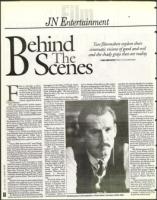
morals and philosophy, Nick Nolte poses as a Nazi sympathizer in Robert Weide's screenplay of Mother Night.