
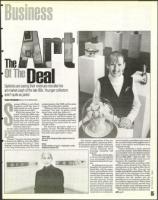

PHOTOS BY DANIEL L IPPITT
Galleries are seeing their revenues rise after the
art market crash of the late '80s. Younger collectors
aren't quite as jaded.
FRANK PROVENZANO SPECIAL TO THE JEWISH NEWS
usanne Hilberry and Albert
Scaglione recall the days of
high-priced art with amaze-
ment, concern and relief.
While they agree that "the
hustle" of the late 1980s more
closely resembled the incivility
of the New York Stock Ex-
change than the calm gallery
world, they are worlds apart
when it comes to conducting the
"business side of art."
Yet few other art galleries can claim
to have had the longevity and success as
the Hilberry Gallery in Birmingham and
Mr. Scaglione's Park West Gallery in
Southfield.
"Success," however, has been attained
in distinctively different ways. Ms. Hilber-
ry searches to show the work of "chal-
lenging" avant-garde artists. She points
to her long relationship with New York
sculptor/painter Judy Pfaff, and her gutsy
Lucian Freud figurative exhibit.
"Selling art can't be reduced to a retail
business," she said. "A gallery owner
should show what they believe in."
Meanwhile, Mr. Scaglione recalls sell-
ing the work of a "well-known artist" in a
profitable deal, and bemoans selling a Pi-
casso for a couple hundred grand when
that painting was resold later for more
than $1 million.
"All business principles apply to a
gallery," he said. 'We offer people an op-
portunity to put something in their home
that holds and appreciates in value."
Above right:
Arlene Selik of Sybaris Gallery takes the show on
the road.
Below:
Susanne Hilberry is loyal to "challenging" artists,
despite the financial risk.
The distinct approaches of the two
gallery owners reflect a perpetual dilem-
ma among art galleries: is art a business,
or should art aspire to higher values and
provoke questions about
meaning, humanity and
beauty?
Fortunately, there's plen-
ty of room for both galleries
in an increasingly vibrant
local and national art mar-
ket.
An informal survey con-
ducted by The Jewish News
found that, with few excep-
tions, local galleries have
recorded increased revenues
over the last 18 months and
are optimistic about the
business upswing. During
the last three years, sus-
tained national economic
growth has led to more buy-
ing in nonessential (or lux-
ury) items such as paintings,
watercolors or sculptures.
And it's hardly a coincidence that some of
the most financially stable galleries are lo-
cated in the region's most affluent area,
Oakland County.
"There's definitely a brisk recovery
around the country," said Gilbert Edelson,
vice president of the Art Dealers Associa-
tion of America, located in New York City.
"It's not 1989, 1990 — that was wild — but
it's more solid now with much more en-
thusiasm. It's a healthier market."
The national trend, according to Mr.
Edelson, can be traced to the collectors
coming back to the market after the in-
flated prices of the '80s; when art was
bought and sold like commodities. The mil-
lions paid for the paintings of van Gogh,
Matisse or Jackson Pollock drew many
neophytes into the market who ap-
proached art as an investment rather than
for aesthetic appreciation. When these
nontraditional art buyers turned away
from the market, many collectors were left
holding artwork no longer in high demand.
The exorbitant prices at auction hous-
ART page 66