

JULIE EDGAR
STAFF WRITER
he bulldozers are groan-
ing and the hammers
clacking, transforming a
piece of downtown De-
troit into a cultural oasis
of sorts.
The sum total of the
$80-million Orchestra
Place project, begun in Septem-
ber, will consist of a 170,000-
square-foot office/retail complex,
a 250-seat restaurant, a 500-space
parking deck and a public per-
forming arts high school with
recital hall. In addition, Orches-
tra Hall's auditorium will be ex-
panded, along with the lobby.
Renovations to the hall will in-
clude the installation of an eleva-
tor to the balcony, expanded
washrooms and concession areas.
The entire project, which joins
the Detroit Symphony Orchestra
Hall, Detroit Public Schools and
Detroit Medical Center together,
is expected to be completed by
1999.
The Real Estate Development
and Investment Co. (REDICO)
of Southfield, led by president
Robert Sosnick, is developing
Orchestra Place. Rosetti
Associates is the architect, and
Perini Building Co. is general
contractor.
Peter Cummings, director of
real estate for The Fisher Group,
is a board member of the Greater
Downtown Partnership and vice
chairman of the Detroit Sym-
phony Orchestra Hall.
In 1990, Mr. Cummings, the
son-in-law of Jewish philan-
thropist Max M. Fisher, moved
to Detroit from Florida, where he
was affiliated with the Econom-
ic Council of Palm Beach Coun-
ty and was a founding member
of the Martin County Council for
the Arts.
He took a few minutes to talk
about the Orchestra Place pro-
ject and the possibilities it opens
for Detroit's renewal:
Q: Talk about the Greater Downtown Partnership.
A: The Greater Downtown Partnership is a group of business and
Peter
Cummings:
Adding a new
note to the
urban
landscape.
foundation leaders who are appointed by the mayor to the part-
nership, which has a three-pronged mission. It has control of the
Hudson's building and has optioned properties around it, and will
be coming up with a reinvestment strategy for the lower Woodward
corridor, the Hudson's Kern block in particular. The second initia-
tive is coming up with a framework for a larger reinvestment strat-
egy for the central city, which is the riverfront between the bridges
— the Belle Isle Bridge and Ambassador Bridge — and the Wood-
ward corridor from the river to the New Center. The third initia-
tive is to fund an effort through the planning and development
department to come up with an investment strategy for nine oth-
er areas of city.
Q: How did you come to be vice chairman of the DSOH
board?
A: Alan Schwartz asked me to be on the board three or four years
ago. I sat with [DSOH executive director] Mark Volpe and was im-
pressed with the vision he articulated for the symphony.
Q: How will Orchestra Place figure in to Detroit's renew-
al?
A: I view it as creating a southern anchor in the Woodward cor-
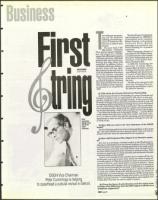
DSOH Vice Chairman
Peter Cummings is helping
to spearhead a cultural revival in Detroit.
ridor that would stretch up to the Detroit Institute of Arts. At Mack
and Woodward, we'll create a rallying point that won't really match
what you have at the DIA and public library but will start to cre-
ate some critical mass that can be viewed as a southern anchor. Then
we have an opportunity to create activities and excitement between
those two points on the corridor.
I talk to a lot of people in the suburbs who've written off the city.
At this point, you've got to show them. There have been so many an-
nounced projects; it's like the messiah has been announced to have
arrived in Detroit, and I think there's a cynicism about it. I know
there have been a lot of projects that were supposed to be the spark,
but [they haven't] brought the city back. I think there's a confluence
of events now that make the opportunity for a rebirth of the city to
be much more viable. It has to do with the economy, the Archer ad-
ministration, the extraordinary commitment of GM, having some-
one like Bob Eaton running Chrysler who's really committed, Gene
Miller running Comerica — a lot of things have come together now.
I think this is the time we need to make it happen.
Q: Given the fears of suburbanites and the aging mem-
bership of the DSO, how does the DSO expect to attract new
symphony supporters?
FIRST page 56