
'Jacques Brel
In Greektown'
I
t's sometimes. a pleasure to get
together with old friends, sip
some wine, reminisce. Jacques
Brel in Greektown, the opener
of the Attic's season, is like such
a memory fest.
Phil Marcus Esser and Bar-
bara Bredius have, for the fourth
time, collaborated on Brel mate-
rial, including their production
of Jacques Brel is Alive and Well
and Living in Paris. That one
opened locally in 1973 and ran
for a year and a half. And this
production picks up, literally,
where that one left off, with the
haunting "Quand On N'a Que
L'Amour."
Brel, who seemed to combine
the smoky atmosphere of a
French cabaret with a cunning
use of rhyme and poetic images,
and Mady Dessimoulie on ac-
cordion.
But why, then, is this such a
dour and lackluster enterprise?
Esser opens the show with a short
essay on Brel, but his enthusiasm,
unlike Brel's, is hidden under a
bushel. Songs suddenly stop with-
out much closure. The set is not
credited; it's downright shoddy.
Can it be that Esser and
Bredius are miked? If so, why?
Each has more than enough pow-
er to fill the small Attic space.
But, finally, there are Brel
songs and there are Brel songs.
Too many of these are about look-
ing back, sadly; regretting; or
looking forward to death. Sure
there' is a wry edge. Brel had the
capacity to laugh at himself But
by the time the solos and duets in
DE TR O IT J E WIS H NEWS
Barbara Bredius and Phil Marcus Esser join together in yet another Jacques Brel
review in the Attic's Jacques Brel in Greektown.
UJ
94
has created classic songs. Sever- this intermissionless 90 minutes
al are in this show, including the are coming to an end, the tone is
unrepentingly depressed.
haunting "Marieke," which
The last three numbers
manages to be a love song
produce numbness, and
and a wandering min-
THEATER
the finale, "Litany for a
strel's sad tribute to his
Return," is poorly conceived
homeland (Brel was from
and forced into an unaccommo-
Belgium).
Certainly Esser and Bredius dating dramatic shape.
There are small musical gems
know their way around the some-
times tortured lyrics of a Brel in this production, but the setting
song. Esser sings "Le Moribund" is hard and unyielding, like lava
with the grace of a lost soul; the long after the eruption. Brel's
two of them together render "Ne irony and wit are overcome, I'm
Me Quitte Pas" (If You Go Away), afraid, by his own pessimism, and
one of the most heart-stopping of Esser — who put this together—
ballads of love lost, with great may not have done well by his old
pal Brel.
majesty.
There is the music, too,
1/2
superbly played by an inspired
V
trio: Alan Ayoub on guitar/bass,
— Michael H. Margolin
Joseph Palazzolo on piano,
'Kindertransport'
I
t is good to see
Diane Samuels' in-
telligent drama,
Kindertransport, at
the Jewish Ensemble
Theatre; Samuels
takes one of the events
of the Holocaust and
successfully drama-
tizes the accompany-
ing personal loss and
anguish.
The Kindertrans-
port was an effort, in
1938 and '39, to re-
move Jewish children
from the Nazi threat;
selfless parents sent
their children to safe-
ty in, among other
places, England. 'We
live through our chil-
dren — that's how we
cheat death," says Hel-
ga Schlesinger (Cheryl
Leigh Williams).
"War breaks promises," says Lil (Evelyn Orbach), right, to Eva (Dana Powers Acheson), a child
She is "Mutti," who who's been sent by her parents to England to escape the Nazi terror in Kindertransport, at the
sends her daughter Jewish Ensemble Theatre through Nov. 3.
Eva (Dana Powers
Acheson) to England and into the of Helga (Mutti), makes nobility ing from the cast, and invented
arms of foster mother Lil (Evelyn meaningful in human terms; intelligent stage business. But
Orbach). That Lil will eventual- Celibi as Faith seems to hit the Ramsden is defiantly superficial
ly adopt Eva, that Eva becomes right notes of angst and irasci- and mannered. She substitutes
the very English Evelyn (Hillary bility a young woman raised in affectation for feeling, and gri-
Ramsden), turning her back on Evelyn's repressive home of se- maces and groans as if she were
in an English music-hall produc-
her religion and her culture, and crets and shame might feel.
Act I, which has two purposes tion. It Is a hollow performance
in turn, alienates her own daugh-
ter, Faith (ElifCelibi), is Samuels' — to help us to know the outlines deeply out of touch with the char-
dramatic crux. (A feminist theme of the intense personal struggle acter.
The set by Melinda Pacha is
and also to give us a sense
is inferred: men fight
of the maelstrom in the quite good, and Gary Decker's
and die, women live and
Holocaust world reflected lighting, very important for ad-
suffer.)
in the lives of the characters justing mood and time shifts, is
"My suffering is monu-
mental; yours is personal," Mut- — should propel us, drag us into apt. I wish Yaron had found more
ti says to Eva/Evelyn; and Evelyn the vortex. But Rivi Yaron's di- ways to work with Decker and
cries out to her ghost mother that rection is slack, and scenes me- Pacha to delineate those time
she was abandoned. 'Why, Mut- ander and do not build the way lines and squeeze more drama
from them.
ti, did you tear me away from you, Samuels intended.
Bottom line: Without a deep,
Act II, a series of confrontations
send me, alone, to a foreign coun-
try?" At 9 years old, a youngster with ghosts, the past and the pre- mature and honest performance
doesn't understand why her par- sent, and intergenerational con- from the actress portraying the
ents don't come for her from flict, should crackle; it does only adult Evelyn, Kindertransport
Hamburg. 'War breaks promis- fitfully such as in the scene be- can be appreciated, even admired,
tween the adolescent Eva and her but one is not moved and recon-
es," says Lil. .
ciliation of the conflict is stalled.
This is wrenching material; but mother.
Performances,
too,
are
slack
—
there are several very real prob-
(..) 1/2
lems which stand in the way of Lil doesn't come to life. She's a
this production reaching the la- well-intentioned woman who
— Michael H. Margolin
tent emotion in the audience, of takes a child into her home and
awakening pathos and empathy nurtures her — but she also
for this monstrous woman Eve- steals her from her birth mother.
She is not the sweet grandmoth-
lyn has become.
Samuels lays this out beauti- erly type that Orbach would have
Outstanding
1
fully, shifting between 1938/39 us believe. This is not a perfor- Oc) Ct®
and the 1980s. A director and cast mance that takes the risk of be- 0*A -
Very Good
must get it onto the stage. There ing unlovable.
Essentially, the performance ®c
are moments: As Eva, Acheson is
Good
affecting as the lost, lonely young of Hillary Ramsden simply be-
Fair
child and the conflicted adoles- longs in another play. Yaron has JO
cent; Williams, in the small role gotten some good, naturalistic act-
Bagel Barometer
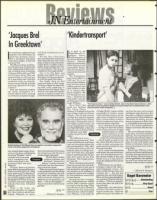
Scanned image of the page. Keyboard directions: use + to zoom in, - to zoom out, arrow keys to pan inside the viewer.
October 18, 1996 - Image 102
- Resource type:
- Text
- Publication:
- The Detroit Jewish News, 1996-10-18
Disclaimer: Computer generated plain text may have errors. Read more about this.