

Slinl Se arching
"(hi hall just 100 years, and there is no question about the afterlife. It's as normative as chalk!' on Shahhos."
where women can walk the streets safely, where men can
communicate to one another intimately." According to one
rabbinic tale, Professor Raphael explains, "for a wagon
driver, Gan Eden has new horses, a new wagon, and he
can drive around forever. You get whatever is within your
own spiritual capacities."
• Finally, Professor Raphael says, some of the mysti-
cal literature makes reference to a fourth stage, tzror ha-
hayyim . Here, at the "source of life," one enters "a place
beyond Gan Eden, underneath the very throne of God,
where the soul gets even closer to the Source of Divinity."
All of this is only a precursor, of course, to the Messianic
era, when (as the rabbis tell us) the dead will be resur-
rected in a triumph of eternal harmony and goodness on
earth.
Standing On The Milt
Rabbi Stanley Davids doesn't quite see it that way, how-
ever. And at age 56, he has been giving the subject a lot of
thought. For the past two years, the spiritual leader of
the Reform Temple Emanu-El in Atlanta has been stand-
ing on the very brink of the abyss. He is dying of cancer.
"It is one of the most painful, difficult challenges that
any of us can confront," the rabbi says. Complicating mat-
ters is the simple fact that "the positions offered within
Judaism are multiple, and often contradictory, so it is not
easy to decide what the 'tradition' has to say."
While the rabbis went out of their way to codify the
rules of Jewish practice, they never offered a very uniform
vision of what Jewish belief ought to entail, especially as
regards the afterlife.
As a result, he says, his congregants often feel guilt and
confusion, when what they believe about death as indi-
viduals does not accord with what they think they are
"supposed" to believe as Jews. Through his own experi-
ence, the rabbi has come to feel simply that "Jews are sup-
posed to believe that there is a God who is the source of
life, and God has created a universe in which we play a
significant role, but in which we are neither the central
nor the sole concern."
This sense of cosmic humility, of understanding one's
very small place in the universe, has helped Rabbi Davids
to come to terms somewhat with his own coming demise.
"What I have tried to do for myself is to separate out
wishful thinking, and needful belief, from the authentic
tradition: to distinguish between what I need
to continue getting up each day, and what
is real," he explains. "It would be very nice
to think that I could have something like
what the tradition of heaven and hell offers,
but that's not where I find myself now."
Rather, Rabbi Davids has developed a be-
lief that he says is based both on mystical Jew-
ish teachings, and on Eastern wisdom. Both
traditions, he says, share a sense of "an un-
breakable continuity of being. In Kabbalah
especially, God is the universe, and the uni-
verse is God. God and the universe are in-
terchangeable, and both are unending."
In this sense, he says, "that which I am
does not disappear."
Rabbi Davids has begun to feel "a sense
of being at one with a universe that ulti-
mately is infinite and without end. Life it-
self is part of a continuum which is without
end. So although an
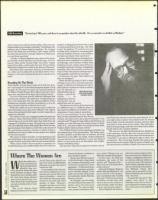
Rabbi Shmuel Irons
individual life may ter-
of the Kollel Institute
minate — and will ter-
of Greater Detroit.
minate — its
subparticles will be re-
distributed" and ab-
sorbed back into the cosmos.
"The literal resurrection of the dead arose
in a different time, in a different place, in
the context of a different set of beliefs. I know
what that is, I know where it comes from —
but it is not compelling," he says. Rather
than envision himself seated at the Throne
of Glory, the rabbi tries to see a place for himself in "the
natural world." He goes for long walks on the beach in Los
Angeles, or in the hills near his vacation home in Wood-
stock, N.Y., and says he feels "very much at home there.
I believe that's where my home will be."
One of Rabbi Davids' earliest experiences of death was
the passing away of his grandmother. "My family react-
ed with a pattern somewhat akin to hysteria, throwing
themselves on the coffin," he recalls, "and my response to
this was not fear but wonderment. I never was afraid of
death; it never occurred to me that death was a fright-
ening or forbidding thing."
And his later experiences helped to reinforce this al-
Where The Women Are
CID
1.1J
(1)
CC
w
LL_I
56
Jewish Views of the Afterlife, the
II
hen the rabbis of an-
cient and medieval
times considered the
afterlife, they wor-
ried a lot about where the souls
of the scholars would go. They
themselves were scholars after
all. And since these scholars
were almost exclusively men,
their vision of the world-beyond
can look sometimes like a boys-
only club.
But, as Dr. Simcha Paull
Raphael points out in his book
•
men who wrote the Midrashim
did pause to ponder the souls of
women as well.
In one medieval text, the rab-
bis promise righteous women
not one, not two, but fully seven
layers of paradise — seven cir-
cles within the heavenly realm,
located on the north side of the
Garden of Eden. Pharaoh's
daughter presides over the first
of these "palaces," wherein dwell
all those who reared orphans,
showed kindness to scholars or
gave charity in secret.
Moses' sister Miriam is queen
in the third realm, where there
are "canopies of tranquility, and
well-known angels have been
appointed..." In the fourth level,
Hulda the prophetess presides,
and in the fifth, Abigail. In the
sixth and seventh circles reign
the matriarchs: Sarah, Rebecca,
Rachel and Leah.
At midnight, say the rabbis,
the Holy Blessed One enters the
garden, and a voice cries out to
the women: "You who are right-
eous, prepare yourselves to meet
most fraternal attitude toward the great beyond. At 17,
as a high-school student who already knew he wanted
to be a rabbi, Davids attended a funeral with the rabbi
who acted in those years as his mentor. The rabbi deliv-
ered a moving eulogy, and then he and the future Rabbi
Davids rode to the cemetery together.
"We were in a car after the funeral service, headed out
to the cemetery, and the rabbi who was my mentor was
exchanging jokes with the driver from the funeral home.
I remember I was rapt in adolescent rage at what I saw
as hypocrisy." But not for long. Davids soon came to per-
ceive in his mentor's jokes "both the horror of death, and
the simultaneous normalcy of death. He was not running
your maker! Blessed are you
who have merited all this glory."
At that time, the Midrash
continues, the souls of the
women will "blossom forth....
They will see and attain their
realm with joy."
Although Professor Raphael
admits that this Midrash is "not
by any stretch of the imagina-
tion a mainstream text," he adds
that such "little known kernels
of wisdom as this show that
what is there in the tradition is
much broader, vaster and deep-
er than what anyone expects."
Rayzel Raphael, the author's
wife and a senior student at the
Reconstructionist Rabbinical
College, is delighted to find even
an obscure medieval reference
to women's souls. The presence
of the women prophets who pre-
side over the souls of the dead in
this Midrash "shows that
women can be powerful in Gan
Eden as teachers, just as are the
men," she says.
Passages like this show "that
women were there in the
Midrashic mind, that we weren't
just relegated to chicken soup.
It's a very positive role model for
today."