
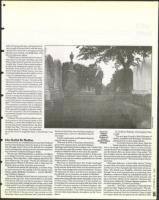

wife went looking for him, and found him ly-
ing in a pool of his own blood, with the man-
uscript of his next book in his hands and
identity card missing. I had had class with
him the afternoon before.
"I didn't have a kind of spiritual experi-
ence out of it," he says, "but then, my next
book is about funeral customs, and I have to
wonder why. I mean, I have sound academ-
ic reasons for choosing the subject, but still..."
Professor Fine knows that he has been
drawn to the topic of death not just "as a way
of understanding the ancient rabbis, but as
a way of understanding myself, too."
"There has been lots of interest develop-
ing in this subject," he says, "not just in the
`spiritual renewal' movement, but among
the ba'al teshuva [newly Orthodox], and
within various elements within the Con-
servative movement."
Although he describes himself as a "tra-
ditional" Jew, Professor Fine admits he finds
it hard to accept the traditional view of the
life hereafter, with its judgment, its rewards
and punishments, its resurrection of the
dead. "I don't know what I believe," he says.
"The question is whether one is willing to
empower God to that extent. For the Reform,
God is powerful enough to make the world,
but not to remake it. For the Orthodox, He
is powerful enough even to plant fossils to
test your faith."
Professor Fine has read the rabbinic texts
that promise a life of eternal study in the
hereafter, a cosmic Beit HaMidrash where
the learned pursue wisdom forever. He kind
of likes that idea. "No one's ever come back
to tell me about it," he says, "but the capac-
ity of the Divine to engender that, is something I hope
for."
Like Challah On Shabbos
It would not be an overstatement to say that Professor
Simcha Paull Raphael wrote the book on the hereafter.
His 475-page Jewish Views of the Afterlife is a masterful
work of scholarship, delving into the rich and varied his-
tory of Jewish mystical thinking on death.
The 45-year-old Philadelphian, a professor of religion
at La Salle University, has seen interest in his subject
growing. "We're less than 1,500 shopping days from the
next millennium," he quips. "People are starting to ask
big questions: What's it all about, and in what way can
Judaism give me tools, resources and answers?
"As part of this search for spirituality, a number of top-
ics have returned to the agenda of Jewish inquiry: med-
itation, angels, Kabbalah, mysticism — and the afterlife,"
says Professor Raphael.
Professor Raphael himself became interested in the
subject at the age of 21, when a friend died in a car crash.
"One day he was here; one day he was gone. I went back
to my apartment after visiting the shiva house, and a meal
he had cooked for me the night before was still in the fridge.
"I had been with him at 6 o'clock on a Saturday night,
and he said he was going to visit his father for motzei Shab-
bos. At 2 o'clock in the morning I was coming out of a
restaurant, there was a full moon, and I turned to another
PHOTO BY JANE HWANG
•
friend and said there was something auspicious
Steven Fine,
So, Professor Raphael, what happens when
professor
about that moon. At 4 a.m., the phone rang. He
we die?
of rabbinic
was dead."
"The soul goes through a kind of journey of
literature and
It didn't make sense, and Professor Raphael
closure, completion and cleansing," he explains,
history at
started asking questions.
adding that it is a four-stage process:
Baltimore Hebrew
"This was in 1973, in the years when all the
University.
• In the first three to seven days, while the
gurus were coming to town, and all the Eastern
family sits shiva, the soul endures hibbut ha-
teachings could answer these questions, but I couldn't find kever, , the pangs of the grave. This is "a time of confu-
any rabbi who could offer answers. There was a whole gen- sion for the soul" as it struggles to break free of this world,
eration of rabbis for whom it was not on the agenda."
and the family often can sense when it has ended. "It's
Professor Raphael's questions led him to write a doc- late at night, and you can't eat another cold cut, and all
toral thesis on Judaism's views of death, and in the mid- the aunts have gone home, and someone says: 'Didn't you
1980s he took a job as a resident psychiatrist at a Jewish just feel momma was here?' " The soul has begun its jour-
funeral home in Toronto.
ney home.
What has he learned about the Jewish teachings?
• First stop: Gehenna, "a time of fire and ice." It lasts
"There is a thread of connection between the world of the no more than 12 months, during which time the family
living and the world of the dead, and the traditional Jew- and the soul of the deceased take their leave of one an-
ish view acknowledges this interconnectedness," he says. other. The family says Kaddish, while the soul goes
"Go back just 100 years, and there is no question about through "not so much a punishment, as a cleansing, a pu-
the afterlife. It's as normative as challah on Shabbos."
rification, a chance to finish up unfinished business. All
This should hardly come as a surprise, since Jews even the unresolved emotional residue of life, the pain, the
today acknowledge life after death repeatedly in the course tears, the fears, all have to be resolved." Gehenna isn't
of daily prayer. The second prayer of the Amidah ac- like the place called hell, Professor Raphael explains. "It's
knowledges the coming resurrection fully five times. And not about geography, it's about psychology."
it surely came as no surprise to Professor Raphael, who,
• And onto ... Gan Eden, a paradise in which the dead
as a 5-year-old boy, held frequent conversations with experience their "highest potential spirituality." The rab-
his dead grandmother. "I have felt the presence of people bis imagined that, for the most spiritually evolved, this
who have died, intermittently, throughout my life," he ex- would mean studying Torah for all eternity. Today it might
plains.
be "a place where you can park your car without a Club,