

Facing The Facts
B
inyamin Netanyahu doesn't like
Yassir Arafat. Ironically, while
the two have never met, Israel's
prime minister-elect has
used the Palestinian Authority
chairman to get where he is to-
day.
Probably the strongest of Mr. Ne-
tanyahu's Likud televised campaign ads
was a pane of glass cracking. It fell away
to reveal the immortal shot of Mr. Arafat
leading Prime Minister Shimon Peres by
the hand. Following it came the stern
warning: "Peres will divide Jerusalem."
Mr. Netanyahu exploited the theme fur-
ther during the candidates' one televised
debate. "My desire, in contrast to Mr.
Peres," he said, "is not to traipse with
Arafat through the palaces of Europe."
Since his victory at the end of last
month, Mr. Netanyahu has continued to
signal his disdain for Mr. Arafat and the
aspirations he symbolizes. Soon after the
election, the Israeli spoke with Egyptian
President Hosni Mubarak and Jordan's
King Hussein. But he had a political ad-
viser call Mahmoud Abbas, the Palestin-
ian architect of the Oslo I agreement and
the PLO's number two man.
Subtle slights to the Palestinians con-
tinue in the new government's Basic
Guidelines in the chapter on peace and
foreign relations. The Palestinians are rel-
egated to sixth place — after references to
Egypt, Jordan, Syria, Qatar, Oman, Mo-
rocco, Tunisia, Mauritania, and Israel's
POWs and MIAs.
And the intention is to continue ne-
gotiations only "on condition that the
Palestinian commitments are honored in
full."
While speaking of negotiations with Syr-
ia "without preconditions," the Palestini-
ans get the maximum that the new
government is prepared to offer — self
rule. And if that weren't clear enough, the
document also speaks specifically of the
opposition to a Palestinian state, to the
"right of return" to any "areas of Eretz Yis-
rael west of the Jordan River," and of its
right to use the Israel army and other se-
curity forces "against threats of terrorism
everywhere."
So far, all these signs point to a con-
tinuation of Mr. Netanyahu's stand pri-
or to the elections: a tacit acceptance of the
post-Oslo situation on the ground, but no
intention of fostering anything like the al-
most symbiotic relationship that the Ra-
bin-Peres government built with Mr.
Arafat.
But as prime minister, Mr. Netanyahu
might have to reconsider a few catches.
One key promise of his campaign was to
return to the IDF (that is, wrest back from
the Palestinian Authority) full responsi-
bility for the security of all Israelis.
But one of the first meetings Mr. Ne-
tanyahu held upon being elected was with
Ami Ayalon, head of the Shabak (Gener-
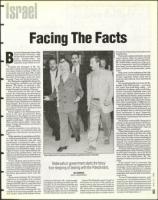
Yassir Arafat enters the meeting of the Palestinian Legislative Council in Gaza City.
Netanyahu's government starts the fancy
foot-stepping of dealing with the Palestinians.
INA FRIEDMAN
ISRAEL CORRESPONDENT
al Security Services). Mr. Ayalon urged,
according to one Israeli journalist, Mr. Ne-
tanyahu "to do everything possible not
to undermine cooperation in the field of
intelligence that has been achieved,
through great effort, between the Shabak
and the Palestinian security services."
Some of the Shabak's recent "coups" in
thwarting acts of terror, Mr. Ayalon re-
vealed, were in fact the result of such co-
operation with Palestinian counterparts.
Mr. Netanyahu is reported to have con-
ceded (in private) that Yitzhak Rabin's
much-denigrated plan to combat terror
through the Palestinians themselves was
bearing fruit.
The broader political conclusion was also
easy to derive. After two years of build-
ing his administration and security forces,
Mr. Arafat holds a card or two of his own.
One is cooperation And if he withholds it
from Israel, he can make the lives of its cit-
izens, and their new government, rather
bitter.
That power, as the architects of the Oslo
process saw it, was one of the achievements
of their approach. Peace could not be
achieved, they believed, if one side held all
the cards.
But complicating life even more for Mr.
Arafat, if the Oslo Accords — or at least
the "spirit" that made them viable — are
on the brink of collapse, oddly not all Pales-
tinians (meaning moderate ones) will
mourn their demise. Reminiscent of the
post-1992 Israeli election, many members
of the Palestinian intelligentsia have ar-
gued that there's little reason for dismay
since there's essentially no difference be-
tween the policies of Labor and the Likud.
Khalil Toufakji, a Palestinian expert on
demography and Jewish settlement, has
even declared that by allowing the West
Bank settlements to grow (especially
around Jerusalem), the Labor government
"essentially implemented the policies of
Ariel Sharon."
He therefore welcomed Mr. Netanyahu's
election on the grounds that it will be eas-
ier to fight a right-wing government, which
is a "clearly defined opponent," than its
"slippery" Labor counterpart.
Other Palestinians note with satisfac-
tion that Mr. Arafat is far from the weak
and isolated leader of four years ago. In
fact, today he holds western backing for
entering into the Oslo agreements and the
support of a united Arab front (now be-
ing built by Egyptian President Mubarak)
in facing the threat to those agreements.
While the Rabin government's greatest
accomplishment, holds Ghassah el-Khat-
ib of Bir Zeit University, was to divide the
Arab world by creating a separate agree-
ment with the Palestinians, Mr. Ne-
tanyahu's election has rejuvenated Arab
unity.
If the Israeli tries to reconvene the
Madrid Conference (as suggested in his
campaign), Arab states, far from threat-
ened, will welcome the move as a chance
to link progress toward diplomatic nor-
malization with Israel to that on the Pales-
tinian front.
To most Palestinians, however, such
musings are of marginal interest. They
want to know about concrete issues such
as if and how their aspirations are now
reachable. But the man who kept even his
closest associates in the Likud in suspense
for weeks about their political futures is in
no hurry to let them know. 0