

HethoIlah
rj-)
I_U
Cr)
LU
CC
F-
LU
LU
1 - -
48
"We have nothing against the
American people," Mr. Musawi
told me in Arabic. "But why
does your government side with
the Jews against the Muslims?"
he said, flashing a sincerely
mystified smile. "Why does it
side with 5 million Jews rather
than 300 million Arabs and
more than a billion Muslims?"
The Jews had a "black fu-
ture," he said. The future be-
longed to Muslims. So America
should improve its relations
with Muslims now, he argued.
"If you recognize your own in-
terests, we will forget all the
past problems between us."
The allusion to unspecified
"past problems" obviously
meant Hezbollah's suicide at-
tacks against American and
Western facilities in the 1980s,
its relentless car bombings, and
the kidnappings and barbarous
treatment of more than 40 civil-
ian foreigners whom it had held
hostage in Lebanon, including
journalists.
American policy had always
been shortsighted in the Middle
East, Mr. Musawi continued.
During the Gulf War, for in-
stance, Washington had "flat-
tened Baghdad and killed half
of the Iraqi people. Why didn't
you just kill Saddam Hussein?"
No Membership Cards
Mr. Musawi obviously was
not opposed to violence that fur-
thered what he considered a
worthy cause, in this case, the
destruction of Iraq's leader.
Hezbollah detested Hussein for
his persecution of Iraqi Shiites.
"Everywhere in the world,"
Mr. Musawi had told one of my
colleagues, "governments main-
tain law and order in the way
they see fit" — an omen of what
Mr. Musawi might do in the
name of "law and order" if
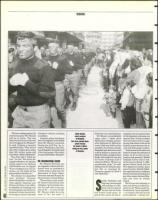
Shiite Muslims
watch members
of Hezbollah,
their faces painted black,
parade through
the streets of Beirut
during the holy month
of Ramadan.
Hezbollah ever ruled Lebanon.
Mr. Musawi was predictably
vague when I asked about
Hezbollah's strength, estimat-
ed by diplomats in 1993 at be-
tween 2,000 and 4,000 militia
members. For almost a decade,
Hezbollah had received as much
as $100 million in annual sub-
sidies from Iran, enough to have
fought and bought its way into
the hearts of perhaps half of
Lebanon's Shiites. "We have no
membership cards," he said,
batting away the tiresome ques-
tion like an annoying fly.
"Everyone opposed to Israel is
with Hezbollah."
S
heikh Fadlallah had
long been preoccupied
with staking out a fall-
back position against
the day that the Arabs
and Israelis made peace. In
speech after speech, he had at-
tempted to set new ground rules
for the Islamists' continuing war
against Zion. If peace treaties
between-Israel and its neigh-
boring Arab states could not be
blocked, peace between the Is-
raeli and Arab people could be.
"Just because Arab states are
forced to accept the existence of
Israel, we do not have to suc-
cumb to such pressure," Sheikh
Fadlallah told me when I visit-
ed his home in Beirut in 1994,
shortly before Israel and the
PLO signed yet another peace
accord in Cairo. Sheikh Fadlal-
lah urged that fatwas (religious
decrees) that barred trading and
any other contact between Mus-
lims and Jews be strictly
obeyed.
Did he have the authority to
issue such fatwas, and did he in-
tend to do so? "Many people" be-
lieved that he, "as an Ayatollah"
— an Iranian title that he told
me he preferred — had the "nec-