

•
.•ti •
",,' , N *1 4:APW4Nae
j4;.1. 11KNA WN.,
s4a
•
••••.? 0.•
•
I also knew that Israel's most
intricate and successful covert
operation against Hezbollah
had never been publicized. This
was in 1985, when 15 people
were killed and more than 55
wounded in an explosion in the
Shiite village of Marakah, near
the southern port of Tyre.
Lebanese officials accused Is-
rael of having planted the bomb
in the village's main mosque,
which Israel denied. In fact, Is-
rael had set the charge that had
destroyed almost the entire re-
gional leadership of the Party
of God and a visiting Iranian
dignitary.
Before it withdrew from the
village, Israel had hidden ex-
plosives and monitoring equip-
ment in the mosque, which was
also a center of political activi-
ties, under a false ceiling that
soldiers had constructed virtu-
ally overnight — an exact repli-
ca of the original but some eight
inches lower. Israeli agents had
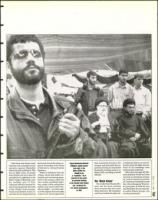
Sayyid Muhammad Hussein
Fadlallah, seated second
from right, is the
Shiite sheikh now
thought of as
a "moderate." He is
believed to have given
his personal blessing
to the suicide truck bomber
who destroyed the
U.S. Marine headquarter s
in 1983.
_
then monitored activity in the
mosque and detonated the ex-
plosives during an important
Hezbollah strategy session in
March 1985, according to Israeli
officials.
The 'Black Future'
No wonder that Hussein Mu-
sawi was far more cautious
about security than his cousin
Abbas had been. My translator
and I had walked through met-
al detectors before we were al-
lowed to enter his office, the con-
tents of our handbags were
meticulously examined.
Only a few years ago, Mr. Mu-
sawi probably would not have
received an American journal-
ist, and an American journal-
ist would have hesitated to meet
him. But kidnapping Western-
ers was passe, at least for now,
and Hezbollah, like so niany oth-
er radical Islamic groups, was
courting Americans.