

■
WINTER 1996 ISSUE
■
SINAI HOSPITAL
Gynecologic Cancers Early Detection is Crucial
T
here's both good news and bad news
' about gynecological cancers (cancers of
the reproductive organs in women).
Many are preventable or curable if they
are caught early, but in many cases the cancer is
well advanced by the time symptoms appear.
Cancers of the lower reproductive tract include
ovarian cancer; uterine cancer, which is either en-
dometrial cancer (the endometrium is the lining
of the uterus) or cervical cancer (the cervix is the
neck of the uterus); and cancer of the vagina
or vulva. Gynecological cancers strike women of
all ages. Endometrial cancer is more common
in post-menopausal women; cervical cancer
usually occurs in younger women, often those in
their early thirties.
"Annual gynecological exams are crucial for de-
tecting these cancers," Alfred. Sherman, MD, said.
Dr. Sherman is Director of the Sinai Hospital Gy-
necological Oncology program and a professor of
obstetrics and gynecology at Wayne State Uni-
versity. "Every woman who is over 18 years of age
or is sexually active should have an annual pelvic
exam and Pap smear," says Dr. Sherman. 'These
procedures are the best ways of finding these can-
cers early and finding them early is the key to suc-
cessful treatment and survival."
Dr. Sherman estimates that about 20,000 new
cases of endometrial cancer will be diagnosed in
the United States this year. Of those, most will
be cured. "We anticipate a 60-70 percent survival
rate," he says. "Close to 100 percent of the women
whose cancer is detected early and treated with
surgery and radiation will survive."
Cervical and endometrial cancers can be de-
tected in their pre-cancerous states by a Pap
smear, which reveals the lesions that precede
them. The lesions can then be treated and the
cancers prevented.
The outlook for those diagnosed with ovarian
cancer is less optimistic. Of the approximately
17,000 women who will be diagnosed with ovar-
ian cancer this year, about 4,000 will survive. The
difference in survival rates may be caused by the
difficulty in finding ovarian cancer before it has
reached an advanced stage.
Usually it can be detected only
by a pelvic ultrasound. Ovarian
cancers tend to grow and spread
quickly. Gilda Radner, comedi-
enne and TV and film star, died
from ovarian cancer.
"We don't have a good clue as
to the possible causes of ovarian
cancer," Dr. Sherman states.
"We do know that a small per-
centage of the cases are related
to abnormal gene factors, so if
a woman's mother had ovarian
cancer, she is considered at high
risk. We also know that women
who have taken birth control
pills for an extended period, five
to ten years, seem to have a low-
er risk of ovarian cancer."
Researchers don't know the
causes of gynecological cancers.
There is some indication that en-
dometrial cancer may be relat-
ed to hormone disturbance. Viral
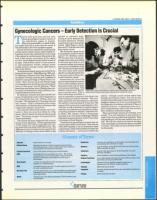
infection may be one of the fac- Laparoscopic surgery allows doctors to look for signs of gynecologic cancer and
tors in cervical cancer. With so remove tumors through small incisions rather than by conventional surgery.
little information available, it
uterus — through a small incision rather than
may be impossible to assess an individual's risk
through conventional surgery. Not only can this
of developing one of these diseases. "The mor-
be
used when performing a hysterectomy for non-
bidity associated with these diseases underscores
the need for continued research in this area. The malignant disease, but it can be incorporated into
support of the community as participants in clin- the diagnostic procedures performed if there is
suspicion of cancer. A laparoscopy does not re-
ical trials, as well as donations to support research
quire hospitalization and it is far less invasive
activities, are of paramount importance as feder-
than traditional abdominal surgery.
al funding continues to decline," comments Vic-
Many gynecologic cancers are treatable, even
ki Baker, MD ; Section Chief of Gynecologic
curable. It is very important to seek medical at-
Oncology at the University of Michigan Medical
tention if you have any abnormal symptoms. Sinai
School and Associate Section Chief of Gynecolog-
will provide you with the best medical care avail-
ic Oncology at Sinai Hospital.
able. We will also continue to improve the diag-
Treatment for gynecological cancers has ad-
nosis, technology and treatment options available
vanced a great deal in recent years. Sinai was one
to
women. The earlier cancer is treated, the bet-
of the first hospitals to use an instrument called
ter
the results.
a laparoscope, which allows doctors to inspect the
ovaries and uterus — and even to remove the
Antenatal
Birthing Classes
before birth has occurred
Obstetrician
educational classes to inform expectant parents about
the birthing process, what to expect, and ways to improve
the experience for both parents and baby
a doctor who specializes in the medical care preceding and
immediately after the birth of a baby
Obstetrics
area of medidne which deals with birth and with the time
before and after the birth
Lactation Consultant
LDRP
nurse with special training about breast feeding
Pediatrician
labor/delivery/recovery/postpartum room. The mother
is admitted to one room during labor, remains there for
the birth of the baby and through her entire stay in
the hospital.
a doctor who specializes in the development, care and
diseases of children
Pediatrics
OB Nurse Practitioner
area of medicine which deals specifically with children
Neonatologist
a doctor who specializes in the development, care and
diseases of newborn babies
Perinatologist
physician who is specially trained to take care of
pregnancies with risks to mother and fetus
NICU
neonatal intensive care unit. Usually categorized as level 3
for more complicated cases
after birth has occurred
Non-stress Test
one of a series of tests (e.g., monitoring fetal movements and
heartbeat) that are used to determine the well-being of the
baby before birth
Postnatal
Postpartum
Prenatal
before birth has occurred
OB ICU
intensive care unit staff by specialists in both intensive care
and obstetrics
nurse with specialized training to deal with the mother and
baby before, during and after birth
the time period during the first six weeks following delivery
of a baby