

Israel's Military Option
The question is when and how Israel will respond, not if.
F
LARRY DERFNER ISRAEL CORRESPONDENT
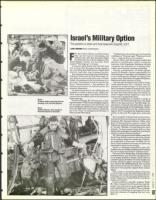
Above:
An Israeli soldier carries bags from the
wreckage of the bus bomb explosion.
Below:
Soldiers attend to a man wounded in
the bomb explosion in Jerusalem.
fifty days before Hamas suicide bombers
blew up the buses in Jerusalen and
Ashkelon this week, Shin Bet agents rigged
and detonated the cellular telephone that
killed Hamas' number one terrorist, Yechi
Ayyash ("The Engineer"), in Gaza.
In summer 1994, shortly after the PLO took
over in Gaza, Shin Bet agents booby-trapped a
car in the Strip that killed Islamic Jihad's chief
terrorist, Imad Akel, when he opened the door.
The consensus here is that since Israeli forces
pulled out of Gaza and the West Bank cities (ex-
cept Hebron) and turned them over to Yassir
Arafat, the response to the bus bombings is in
his hands. The demand is that he wipe out the
terror "infrastructure" — the planners, the
explosives procurers, the indoctrinators, the
terrorists themselves.
But Israel has proven its own willingness and
capability to strike at terror in Mr. Arafat's do-
main. It can do so again, says Shimon Romach,
a senior Shin Bet official, prior to his retirement
three years ago.
The first challenge, Mr. Romach says, is find-
ing the bombers. While Israeli intelligence agents
are no longer operating in the territories, and
their Palestinian collaborators are being hunted
down and killed off by local enforcers, Israel still
has a few "lines" on underground activities in
Gaza and the West Bank.
CC
4
C
C 1. .
<2.
"Collaborators are not the only way to gather
intelligence," Romach said. "There are lots of
ways — tapping phones, for instance."
Karmi Gilon, who left his post as Shin Bet
director in mid-February, said in a television
interview that Palestinian Authority officials
"cooperate very well with us" in sharing infor-
mation about terrorist comings and goings.
Hamas' amalgamation of death squads,
Izzadin El-Kassem, claimed responsibility for
the bombings in Jerusalem and Ashkelon, and
so far Israeli security officials are taking them
at their word. The leader of Izzadin El-Kassem,
Muhammad Dief, operates in Gaza.
Romach said he expects that within weeks,
Israel should know for a certainty who dis-
patched the suicide bombers. At that point, he
said, it becomes a matter of locating them, which
is not easy because they never stay in one place
for long. But if and. when they are located, he
noted, a rigged cellular telephone is only one of
many ways to assassinate them.
A key consideration in whether to strike at
terrorists in the West Bank and Gaza is the likely
effect on the peace process. The Shin Bet's as-
sassination of Ayyash had little effect. Despite
the outpouring of rage on the Palestinian "street,"
and the public objections by Mr. Arafat and his
regime, the PA accepted the Engineer's elimi-
nation; in fact, the PA might have welcomed
it.
So it would be if Israel took out the terror-
ists behind the bus bombings in Jerusalem and
Ashkelon, Mr. Romach believes. "After a few
days [of demonstrations against Israel], the
Palestinian Authority would come to terms with
it," he said. "Besides, it would help solve their
problem. To stay on good terms with us, they
strike at the terrorists now and then, but they're
afraid to confront llamas full-force."
Mr. Gilon and government leaders noted that
the PA has foiled numerous terrorist attacks
in the making. About two weeks ago, Palestin-
ian policemen in Gaza shot to death two Is-
lamic Jihad members who were on their way
into Israel to carry out an atrocity.
There is a seeming contradiction here: Mr.
Arafat's men are willing to kill terrorist bombers,
but not to attack the broader "infrastructure."
Ha'aretz's Ze'ev Schiff, dean of Israeli military
correspondents, says the PA's war against ter-
ror is largely limited to Islamic Jihad, which is
a splinter group of killers who have hardly any
broader political support among the Palestin-
ians. The PA, Mr. Schiff explained, "has not acted
against Hamas because it is afraid to — Hamas
has much more popular support than Islamic
Jihad."
_ This, finally, is Israel's problem: It has the
power to wipe out the terrorists behind the bus
bombings, but not the movement behind the ter-
rorists. Hamas can always find new recruits to
replace old martyrs.
Israel's problem is also Mr. Arafat's. While
Mr. Gilon repeated the oft-heard line that Mr.
Arafat "can and must do more against the ter-
rorist infrastructure," he added, "Once an Islamic
terrorist is committed to carrying out an at-
tack, the chances of stopping him are very
slim." ❑