
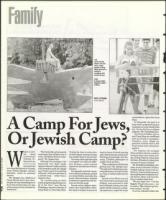

Left:
Jonah and the
Whale: Over the
years, young
people at Camp
Maas have built a
variety of
sculptures with
Jewish themes.
Right:
A camper lights
Shabbat candles
at Maas.
RUTH LITTMANN
STAFF WRITER
A Camp For Jews,
Or Jewish Cam
vvi
hat's so Jew-
ish about
swimming?
Nothing. Un-
less you've ex-
perienced
summertime
at a camp like Ramah in Canada,
where Debbie Spiegel, a former
Detroiter, works as assistant
director.
Ms. Spiegel says children at
Camp Ramah learn that swim-
ming is not only something fun to
do on hot summer days, but also
a life-saving activity dictated by
Jewish law.
"The Torah tells us that parents
must teach their children how to
swim. God forbid they're endan-
gered," Ms. Spiegel says.
Although the message is not
hammered over their heads,
campers discuss it with members
of the waterfront staff Ms. Spiegel
says Torah is part of everything
at Ramah, which she describes as
a Jewish camp — rather than a
camp for Jews.
"At a Jewish camp, you have
Judaic programming that goes on
all of the time," says Harvey
Finkelberg, executive director of
Camp Maas in Ortonville, Mich.
"A camp for Jews is a place Jew-
ish kids attend, but beyond that,
you wouldn't know it was Jewish."
Knowing which type best suits
a youngster can make the differ-
ence betWeen a good summer
experience and bad case of home-
sickness.
For example, at Jewish camps,
such as Maas and Ramah, prayers
are recited before and after the
meals, which are kosher. Shabbat
is treated as a special day with ser-
vices and Jewish songs.
Ramah carries religious obser-
vance a few steps further. Direc-
tors require campers to pursue at
least six hours of Jewish learning
each week during the school year.
Mornings at camp begin with dav-
ening. Children participate in
weekly Torah portions.
"They understand what they're
getting into," Ms. Spiegel says.
"The kids don't rebel because day-
ening becomes as normal to them
as a class in sailing might seem to
others."
Ramah is the official camp of
the Conservative movement, and
children unaccustomed to that
kind of lifestyle at home, but look-
ing for Jewish content in a camp-
ing experience, might feel more
comfortable at a place like Camp
Maas.
In Ortonville, the goal is to
keep Jewish programming alive
constantly, at every minute of the
day, "but we don't run a religious
program," Mr. Finkelberg says.
One-third of children who at-
tend Camp Maas are unaffiliated
with any temple or synagogue.
Therefore, every village ap-
proaches Judaism from a less
Torah-based, more cultural per-
spective.
For instance, the youngest
Maas children devote a week to
learning about each Jewish holi-
day. During "Passover," they study
the Book of Exodus by hiking from
one part of camp to another.
Mr. Finkelberg highlights a few
other Jewish elements of Maas.
Challah baking occurs in the au-
ditorium. Drama performances hi
the amphitheater emphasize Jew-
ish themes. More and more He-
brew is spoken these days.
'We go to (-1Pgel now — not the
flagpole. We go to teva now — not
to nature. The campers get kee-
bood (candy)," he says.
A survey released within the