

have evolved, even multiplied, over time.
At first, he told his wife he still loved
her and did not want the marriage to
end. He later offered a second reason,
saying he wanted her to return a few
thousand dollars in coins, gold and an-
tique jewelry he claims she had stolen
from his business — a figure he has since
revised to more than $400,000. It is this
alleged theft, he said, that has left him
bereft of money to pay child support and,
for a time, homeless. Mrs. Abraham de-
nies stealing the merchandise.
Recently, Mr. Abraham added anoth-
er condition to furnishing his wife a get.
He wants her to relinquish her right, un-
der a court order, to primary physical
custody of their daughters, Shoshanah,
9, and Sharonah, 7.
"If I can't get custody, I want a hell of
a lot more visitation than she's been giv-
ing me," he said. 'They are my kids, too."
Bernard Cohen, Mrs. Abraham's at-
torney, said the husband's real motive is
neither economic nor familial. "It's all
about control," he said. "He's a control
freak."
"I think he thinks he's torturing me,"
Mrs. Abraham said. "It's revenge. He
feels that either he can prevent me from
getting married again or that I will mar-
ry without a get and wipe out all my re-
ligious beliefs, just wipe myself of
Judaism — like he can break me down
to nothing, one way or another."
But Mr. Abraham has his backers —
most prominent among them, Rabbi Sil-
berberg, who takes a traditional ap-
proach to marital matters.
He, for instance, attributes the ris-
ing divorce rate in the Orthodox Jewish
community in large part to the chang-
ing roles of women. "The more women
become part of the workforce," he said,
"the more independent they become."
In 1993, shortly before the Abrahams' civ-
il divorce was finalized, Rabbi Silberberg and
two other rabbis urged Mrs. Abraham to take
a polygraph on the question of her husband's
"missing" jewelry.
Under the questioning of an examiner
chosen by the rabbis, Mrs. Abraham took and
failed the test.
That was enough for the rabbis, who de-
clined to convene a bet din to pressure Mr.
Abraham into granting a get. "We thought
we had a simple resolution to the case," Rabbi
Krupnik said of the polygraph. "But it didn't
work out, unfortunately."
Rabbi Krupnik said if a bet din were con-
vened today, he would excuse himself from
the panel. "I have to admit I probably would
have a bias I didn't have earlier on be-
,••••••",
(
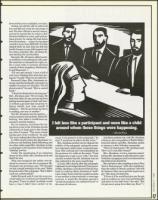
I felt less like a participant and more like a child
around whom these things were happening.
Stacie Fine
cause I was present at the polygraph," he
said. "I would not be able to be fair to her."
Mrs. Abraham and her lawyer dispute the
validity of the polygraph, saying the exam-
iner improperly asked vague, compound ques-
tions. She contends she was intimidated by
the presence of a rabbi at the exam. "I just
felt desperate to get it over with," she said.
And she wonders why Mr. Abraham was not
also subjected to the same questioning.
In June 1993, shortly after the polygraph,
Oakland Circuit Judge Deborah Tyner grant-
ed Mrs. Abraham a civil divorce from her hus-
band. In ordering Albert Abraham to "seek"
a get, Judge Tyner cited the couple's promise
to one another in their ketubah, or marriage
contract, in which Mr. Abraham agreed to
"accept the guidance of a rabbinical court" in
the event of a divorce.
And there matters rest, with Mr. Abraham
relying on the sympathies of Rabbi Silber-
berg and others, and Mrs. Abraham unable
to remarry in the Orthodox community.
"The love I had is gone," Mr. Abraham said.
"How can I trust this woman?"
Mrs. Abraham, in turn, remains resent-
ful that Mr. Abraham is still allowed to enter
Orthodox synagogues and is not shunned as
she believes he should be.
She said she is also weighing a trip to New
York to find someone "with more backbone"
than the rabbis in Detroit, someone "who will
do whatever they can to get him to give me a
get." She does not elaborate.
"I'd love it if he would just give me the get
and we could go our own way and befriendly
and share in our kids' lives," she said. "But
it's just never going to be that way. Ever."
❑
c)
ti
CNJ
w
CO
O
47