

5 ■
HealthNews
FALL 1995 ISSUE
■
SINAI HOSPITAL
New Diagnosis and Referral Clinic
for Autoimmune Diseases
magine the following scenario.
You have been feeling lousy for
a long time. Your family and
friends have gotten tired of
hearing your minor complaints
about not feeling well. You final-
ly drag yourself to a doctor with a
list of symptoms that are vague, in-
consistent, and sound so trivial.
But the fact is you feel awful.
Unfortunately, the doctor finds
nothing specifically wrong with
you. After some time passes and
you still don't feel better, you go to
another doctor, who may send you
to still others, and yet nothing is
found to be wrong. Maybe some-
one adds insult to injury by saying
that it is all in your head.
You can spend years (not to men-
tion thousands of dollars) search-
ing for someone to find out what is
making you feel this way. You
probably can't even remember
when you didn't feel poorly. There
is a possibility that you have an
autoimmune disorder.
Autoimmune diseases are a fam-
ily of about 80 diseases — some
are very obvious and can easily be
diagnosed, some are very vague
and obscure.
A person's immune system
works to eliminate dangerous ma-
terials which enter the body, such
as bacteria and viruses. When an
autoimmune disease occurs, the
immune system responds in an
equally hostile manner to some tis-
sue in the person's body, causing
inflammation and cellular de-
struction. This can result within
different areas of the body, with dif-
ferent symptoms associated with
the damage.
There are varying theories as to
what causes the immune system
to be sensitive to the person's par-
ticular tissues. Regardless of the
cause, the effects can range from
nuisance symptoms to devastating,
even deadly, situations. Until a di-
agnosis is made, treatment is lim-
ited to symptoms and may be
misdirected.
Sinai, in collaboration with the
American Autoimmune Related
Diseases Association, has estab-
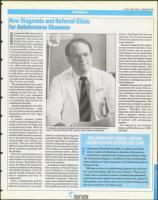
"Our diagnosis and referral clinic should minimize the frustration for people searching for
answers," says Steven Rabinowe, MD, chairman of Sinai's Department of Medicine.
lished an autoimmune diagnosis
and referral clinic. Rather than go-
ing from specialist to specialist,
thereby missing the big picture, a
patient can be evaluated to deter-
mine whether an autoimmune dis-
ease or syndrome exists. After a
diagnosis is made, the patient can
then be referred to the appropriate
physician or clinic for specialized
care and treatment.
According to Steven Rabinowe,
MD, chairman of Sinai's Depart-
ment of Medicine, "A thoughtful
standardized approach to patients
with autoimmune illness has been
needed for a long time. These dis-
eases cross standard medical spe-
cialty lines, and patients have been
having difficulty with the medical
system. Sinai hopes that this new
approach will provide improved
services for patients with autoim-
mime diseases."
Research suggests that autoim-
munity clusters in families. Hone
family member has an autoim-
mune disease, it is not unusual that
other family members do too. For
example, former President George
Bush and his wife, Barbara, both
have Graves' disease; and their son
Marvin has Crohn's disease. This
lack of knowledge and collabora-
tive effort in the traditional med-
ical community can result in untold
suffering for people with these ill-
nesses due to misdiagnosis and de-
layed diagnosis.
Medical advances have benefit-
ed patients with many of the au-
toimmune diseases, such as lupus,
type I diabetes, and rheumatoid
arthritis. These advances have
brought about better treatments
and increased life expectancy. The
greatest cause of death in autoim-
mune diseases is lack of early di-
agnosis. Therefore, this new
diagnostic and referral clinic can
make a physical, mental, and
financial difference in the lives
of patients with autoimmune
diseases.
For referral to one of Sinai's
clinics, call SinaiSource at 1-800-
248-3627.
nflammatory Bowel Disease (IBD) is a collective term that
covers a number of inflammatory disorders of the gastroin-
testinal tract, including Crohn's disease and ulcerative colitis.
The Autoimmune Diagnosis and Referral Clinic would identify
these problems and refer the patients to the Inflammatory Bowel
Disease Center.
"IBD does not have to be debilitating if patients are well cared
for," says Jason Bodzin, MD, the center's director. "This is a new
facility where a significant number of medical and paramedical
professionals come together to provide treatment and support for
IBD patients, most of whom have had a hard time finding a group
like this to help them " Dr. Bodzin said.
,