

OTHER HAND page 14
Lee Goosen Siegelson, former Detroiter and Cranbrook alumnus,
travels the world collecting rare and unusual jewelry.
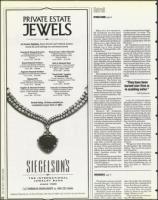
Natural Fancy Yellow Diamond
Emerald & Diamond Bracelet
1 radiant cut diamond 11.53cts,
2 side trillion diamonds 1.53cts
Platinwn/18KYG.
Lot no. 00654 $110,000
139 green emeralds 17cts and
129 round diamonds approx. 17cts.
Platinum.
Lot no. 1752 $47,000
Round Diamond Necklace
Ruby & Diamond Ring
1 center round diamond 2.86cts and
95 round diamonds 25.82cts. Platinum.
$90,000
Lot no. 299
1 oval faceted ruby 7.76cts surrounded
by 44 baguette and round diamonds.
Approx. 3.00cts. 18KYG.
$75,000
Lot no. 4639
Baguette Diamond Necklace
201 baguette diamonds 65.00cts. Platinum.
$125,000
Lot no. 438
"David Webb" Sapphire
& Diamond Ring
Diamond Pin
115 baguette, round and pear
shaped diamonds 21.00cts. Platinum.
$20,000
Lot no. 1114
15 square sapphires 7.50cts and
50 baguette and round diamonds 7.00cts
Platinum.
$36,000
Lot no. 4696
Sapphire & Diamond Necklace
Emerald Cut Diamond Ring
1 center heart shape sapphire 40.00cts.
Approx. 42.00cts diamonds. Platinum.
(shown below)
$175,000
Lot no. 390
1 emerald cut diamond 6.18cts.
Platinum mounting with
2 tapered baguettes.
$46,000
Lot no. 00746
Partial listing. All items available for
examination in your home or office.
1
■ 11111/
dt\N
THE INTERNATIONAL
JEWELRY BANK
SINCE 1920
Call NORMAN ROMANOFF at: 800 223-6686
Siegelson's Diamonds, Inc. 56 West 47th Street, New York, NY 10036 * 212-719-2724 • Fax 212-764-7611
There are a few exceptions.
Mr. Goldsmith, who has spent
the last several years studying
anthropology books and medical
journals, reports that the Zuni
tribe in Africa believed left-hand-
edness was a sign of good luck.
The Incas of South America
dubbed one of their greatest
chiefs the "Unforgettable Left-
Handed One."
An estimated 10 to 15 percent
of the United States' population
is left- handed. Famous lefties in-
clude Leonardo de Vinci, Ben-
jamin Franklin, former President
George Bush, current President
Bill Clinton and Ross Perot. Bart
Simpson, though somewhat am-
bidextrous, mostly uses his left
hand.
Some studies have shown that
left-handers have shorter life ex-
pectancies than their northpaw
counterparts. The former are
more vulnerable to injuries and
accidents and seemingly more
prone to physical and emotion-
al illnesses.
"Many left-handers become
underachievers who live their
lives in constant frustration," Mr.
Goldsmith says.
Scientists are uncertain about
what causes left-handedness.
Many believe it has something to
do with the side of the brain con-
trolling motor skills. Some have
called it a birth defect.
However, Mr. Goldsmith
maintains'you don't have to be a
scientist to understand what
causes a lefty's anguish. His book
is primarily devoted to flagging
everyday impediments to success
in academic, personal and recre-
ational activities:
For instance, Chapter 9 dis-
cusses the need for special school
desks, without which left-hand-
ed students must contort their
bodies to write clearly. Three-ring
binders also present challenges.
Pieces of lined paper, the kind
with holes on the left side, force
lefties to conform to a right-hand-
ed slant. Their penmanship of-
ten suffers, and this generally
affects their grades, especially
when "neatness counts," Mr.
Goldsmith says.
The author cites several other
arenas in which left-handers con-
front problems: the tennis court
and the highway.
"Automobiles have been de-
signed through the years for the
comfort and convenience of right-
handed people," he writes. "The
right hand can more easily reach
the radio, temperature and wiper
controls, while it is virtually im-
possible to operate them with the
left hand."
Mr. Goldsmith contends the
left-handers movement, which
began about a generation ago, be-
came too demanding and turned
people off with kitschy slogans
like: "Only lefties are in their
right minds." More than 100 left-
handed supplies stores have
opened in the last 20 years. Most
have survived less than a year.
Mr. Goldsmith hopes his book
will encourage a resurgence of in-
terest in left-handed people. He
recommends it as required read-
ing for teachers and parents of
lefties.
"They have been
burned over fires or
in scalding water."
Jeff Goldsmith
In fact, Mr. Goldsmith calls for
all sensitive educators — be they
English teachers, gym teachers
or driving instructors — to re-
search the obstacles left-handed
students encounter. They should
refrain from criticizing, he says.
Instead, teachers must help stu-
dents understand that left-hand-
edness isn't a difference of which
they should be ashamed.
Be encouraging, he advises.
Provide left-handed students
with the proper equipment, the
same any right-handed child
would receive. Don't force them
to switch hands and face torment
similar to King George VI of Eng-
land, who began to stutter and
stammer as a result of this con-
trivance.
"Things are better these days
for left-handers," Mr. Goldsmith
reflects. "But it's still not as good
as it should be."
Mr. Goldsmith, who in recent
years owned a store for left-han-
ders, has self-published his book
and will independently distrib-
ute it. For more information, call
Left Hand Publishing Inc. at
(810) 615-3500 or 1-800-511-
LEFT. ❑
MEMORIES page 15
The division went on to march
through Germany. The journey
was grueling. "Day, night, Satur-
day, Sunday, we ate where we
could, we slept where we could."
Breakfast, lunch and dinner
comprised C-rations, canned stew
or hot dogs with beans, which Lt.
Sacks often made into soup
stove. No wonder, then, that there
was nothing like a package from
home; Bea often sent salamis.
One evening the men were set
to go to bed when the general
called Lt. Sacks to his tent. He
asked: "Where are we?"
"That's how fast we were mov-
ing," Mr. Sacks recalls.