

anks For The
Memories
A World War II vet
finally gets his honors.
ELIZABETH APPLEBAUM ASSOCIATE EDITOR
PHOTO BY ANDREW SACKS
school, a three-month crash course.
The day began at 7 a.m. Lunch was
at noon. Classes continued from 1 6
p.m. Officially, lights went out at 9
p.m., but most of the men stayed up
studying until 2 or 3 a.m.
At least once a week there was a
special program. "It would be around
7 p.m. and we would hear, 'Be pre-
pared for an overnight hike,' Mr.
Sacks says. 'We would get back in
time for our first class in the morn-
ing:,
It was some of the last words he
heard in class that Mr. Sacks re-
members best:
"Take a look around you," his in-
structor said on the
last day of class at of-
Abe and Bea
ficers training school.
Sacks: "Every "One of every three
man who was will be a casualty. One
in the Army
of every five is not
has a story."
coming back."
Meanwhile, Lt.
Sacks married his girlfriend, Beatrice (during
training she would come down from New York,
always accompanied by a chaperon, to visit
Abraham). They lived together at various
camps before Lt. Sacks was assigned to the
Seventh Army and shipped off to Casablan-
ca. From there, he went to Naples, where he
arrived Jan. 10, 1944. Soon, he was promoted
to first lieutenant.
Before enlisting, Abe Sacks had worked in
retail, a skill his superiors in Italy were eager
to utilize. They put him in charge of the PX,
where he oversaw $75,000 a month in sup-
plies. Cigarettes cost 50 cents a carton.
In September 1944, Lt. Sacks was sent to
fight in France. Working in signal intelligence,
he helped monitor radio transmissions, which
were then sent to Army headquarters, in-
cluding the camp of Gen. George Patton. He
kept a record of everything he sent and, to this
day, his secret scrawls are contained in a black
address book. "Taken under fire" and "reoc-
cupied" are some of the few readable words.
-
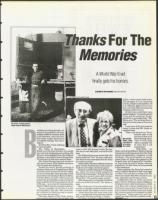
Abe Sacks, working with the
Signal Corps in World War II.
x"s" Ab*:."•''=".SRM• •
ea Sacks was sorting through a col-
lection of her husband's war mem-
orabilia, stuffed in a steamer trunk
in the basement, when she stum-
bled across a paper that bore an
unreadable message. She was in-
trigued.
Ent Bnze Star it read, referring
to various battles.
Mrs. Sacks, of Huntington
oods, is not the kind of person who usually
has much luck deciphering such writings. But
this one was immediately clear. Her husband,
Abraham, was entitled to several Bronze Stars.
Yet she knew he had never received them.
Mrs. Sacks' discovery last April was the re-
sult of pure chance. What followed was the re-
sult of a great deal of planning.
Earlier this month, friends and family of
Abraham Sacks met at Temple Emanu-El for
a surprise party to honor the former soldier.
It was an evening Mrs. Sacks describes as both
joyous (there was dancing to Benny Goodman
and Glen Miller and other 1940s music) and
somber (the grandchildren could not help but
linger at photos of serviceman about to set sail
for Europe — men whom Mr. Sacks later iden-
tified as "killed, injured or missing in action").
"It was a nostalgic trip for those of us who
lived through it," she says. "But it was a les-
son in history for those too young to remem-
ber, or those not even born."
This story begins in New York, where a
hard-working immigrant, Samuel Sacks, had
come in 1907 after leaving Latvia. He mar-
ried, found work selling fish, and had five chil-
dren.
One of Samuel's sons was named Julie. The
family called him "Yud." He was a sickly boy,
and when he was conscripted into the Army
his mother panicked.
Julie's brother Abraham offered to take his
place. Certain American boys would never ac-
tually be sent to fight, the family agreed.
Abraham was first stationed at Ft. Benning,
Ga., where "we were so badly equipped we
trained with broomsticks." At dinner time, the
men dined on canned rations left over from
World War I. The monthly salary was $21.
"After buying all my necessities I had $1.50
at the end of the first month," Mr. Sacks re-
calls.
Many of the men in his unit couldn't read
or write, so Abraham would send letters home
on their behalf His religion wasn't an issue
— "I don't think they even knew what a Jew
was"— though they had a hard time with the
fact that he was from up North, a Yankee.
Abe Sacks enrolled in officerstrairting
MEMORIES aaae 16