

Detroit Businessman
Plants A Seed For Peace
ohn Wallach stood in front of the
Seeds of Peace campers as was his
custom before meals, This time he
asked the teens a series of ques-
tions before introducing the day's guest.
"How many of you want to be doctors?"
he asked. Several hands immediately shot
up. "How many of you want to be lawyers?"
he asked. Again, some hands were elevated.
When Mr. Wallach asked how many
wanted to be businessmen and women, a
sea of hands were raised.
The sight was a pleasing one to the guest,
Joel E. Jacob, a Farmington Hills busi-
n.essrnan and incoming Seeds of Peace board
member.
When Mr. Jacob first met the Seeds of
Peace founder, he was so impressed with
Mr. Wallach's concept that he got involved
through fund-raising.
Now, he is arranging to bring his Detroit
youth-training program to the Middle East,
where he plans to set up shop in Seeds of
Peace regional recreation centers.
"When I founded the Detroit Business
Initiative (a nonprofit organization
teaching Detroit youth how to create
their own businesses), we started seeing
the success involved in giving inner-city
youth hope through entrepreneurship,"
he said.
Mr. Jacob drew parallels between the
teens his program currently benefits and
those living in the Middle East.
"When kids are bored they get them-
selves into trouble," Mr. Jacob said,
"They (teens in the Middle East) face
some of same issues as kids from the in-
ner city. Those with no clear vision of the
future participate in illegal activities."
On Aug. 31, Mr. Jacob traveled to
Maine with several business and com-
munity associates, including Walter
Lockett, project coordinator of the "I
Have a Dream" Foundation; Bill Schul-
man, co-owner of Camp Sea-Gull; David
Gamlin, the director of the Detroit Center
for Entrepreneurship; and business associ-
ates Torn Herrmann and Michael Raykhin-
shteyn. Israel native Eitan Bienstock, who
is visiting Detroit and learning about the
business initiative, will be closely involved
with getting the program off the ground in
the Middle East.
The group went to see Camp Androscog-
gin and meet its participants, whom they
hope will be involved in Mr. Jacob's program.
In the coming months, Mr. Jacob will
meet with business leaders in the Arab-
American community to discuss his initia-
tive and gain local support.
"Seeds of Peace is one of the best-kept se-
crets in country," Mr. Jacob said. "Because
it's so new and the peace process is hap-
pening so quickly, things are developing at
a rapid pace. These teens are a natural to
work with.
"It's my belief that when there is hope,
there is a future. Entrepreneurship gives
people hope, and I believe there is hope for
youth in Detroit as well as youth in the
Middle East." ❑
j
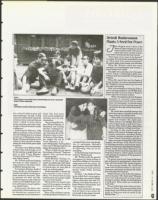
Above:
Open dialogue and working toward understanding are key to a successful
Seeds of Peace experience.
Right:
Coexistence sessions often lead to hurt feelings.
it's a place for kids to grow and
share and hope," he said. "A drip
turns into a drop before it becomes
a stream, then a river and then an
ocean. I think we have future
prime ministers and other lead-
ers here who will be able to make
a difference."
Following the February 1994
Hebron massacre, when an Israeli
shot 40 Palestinians in a mosque
at the Cave of Machpelah, former
Seeds of Peace participants wrote
a letter to their respective leaders,
asking for Arab-Israeli peace talks
to resume.
The teens wrote different drafts
of their letter and through use of
the fax machine a single letter was
sent to both Prime Minister
Yitzhak Rabin and PLO Chair-
man Yassir Arafat.
Mr. Wallach said encouraging
the teens to work together, in
ways similar to this peace letter,
is difficult during the year.
To maintain dialogue, Seeds of
Peace sends its participants a
monthly newsletter containing ar-
ticles written by the teens. Year-
ly reunions are held, and Mr.
Wallach hopes to open regional
centers in the Middle East so for-
mer participants can get together
on a regular basis.
During camp, the teens, who
had already found reason to use
the Internet as a research tool,
were exposed to the Internet so
those who had never
been on-line could learn
and later use it for com-
munication.
One evening after din-
ner, Michael Hessel, of
Maryland, was "surfing
the Net," looking for in-
formation about the pop-
ular television show The
Simpsons when a color-
ful display of Bart Simp-
son caught the eye of
Tarek Shamma, a 13-
year-old Egyptian. Tarek pulled a
chair next to Michael and the two
began discussing the show.
"When we first met, we were at
the bottom of the pit," Tarek ex-
plained. "Now, we are at the top
of the mountain."
Added Michael, "During a 'co-
existence' at the beginning, I
wasn't very diplomatic with Tarek.
After, I felt bad, and with the help
of a third party we were able to
reach an understanding."
Tarek responded, "I wasn't the
type of person to say I hate Is-
raelis. I've always had an open
mind because my parents taught
me never to be biased."
When Tarek was chosen to be
a part of the program, he said he
considered it an honor, and his
parents were pleased for the
opportunity.
Many of the children' parents,
including Michael Hessel's, en-
couraged their sons and daugh-
ters to participate. Michael's
grandparents, whom he describes
as right-wing, were not as en-
couraging..
"I started hating Arabs because
of them," Michael said.
Mr. Wallach calls the parents
courageous for being willing to
send their children to America to
make peace with the enemy. He
said it can be especially difficult
for some because Arab terrorist
groups target Arabs favoring
armistice.
On Sept. 7, the Seeds of Peace
teens ended their camp session.
The last days were spent in Wash-
ington, where they met with U.S.
officials including Secretary of
SLite Warren Christopher and
Vice President Al Gore.
Mr. Gore stressed to the teens
that the future is up to them. It's
not enough to sign papers, he said.
Real peace is in your hands.