

The After Schoo
MARCIA DANNER
SPECIAL TO THE JEWISH NEWS
I
t's not easy arranging an says. "Now there's a lot more
after-school schedule. To- competition for a child's
day, kids have a wide time."
choice of sports, music
For piano teachers, the
lessons and other en- dilemma is how to keep kids
richment programs to fit with an overcrowded sched-
around schoolwork and syna- ule in a discipline that
gogue classes.
requires a major commit-
The calendar fills up fast.
ment.
Ten-year-old Hilary Hayman
"Few students stay with pi-
of West Bloomfield takes piano ano the 10 years it takes to
and dance lessons on Monday, play advanced literature," she
goes to Hebrew on Tuesday, says. "But taking piano even
practices with her swim team on a short time provides a good
Wednesday and Thursday, foundation. Music lessons are
and by Friday is ready for
some unstructured time.
"Friday was Girl Scouts,"
she explains, "but I needed
a day off to have friends
over."
If there was more time,
Hilary says she would take
tennis and ice skating, too.
"She wants to try every-
thing," says her mom, Ani-
ta Hayman. Like most
parents today, Mrs. Hay-
man spends a large chunk
of time driving to after-
school activities and to birthday one of the few opportunities
parties, sports and Sunday to have a one-on-one rela-
school.
tionship with a teacher. Kids
Mrs. Hayman has seen youth who have piano first do bet-
activities escalate since her old- ter when they start in a
est daughter Mindy, now 25, was school band or orchestra," she
growing up. "Now kids do it all. says.
There's so much to choose from
While parents want their
— the activities at the Jewish child exposed to the arts —
Center, enrichment classes from piano, another musical in-
community education, youth strument, dance, theater and
sport teams of all kinds, the visual arts — they also put
dance studio classes at the MA 11, sports and fitness high on the
etc.
list. They want their kids to get
"Kids need lessons to explore exercise and avoid the couch-
their options and find out what potato syndrome.
they have an aptitude for," Mrs.
The team experience is also
ci) Hayman says. "Coaches and very important, since teamwork
,_., teachers can provide guidance is such an important life skill.
and instruction in areas where
Joan Littman, a parenting con-
=
(..) parents don't have expertise. For sultant for Pontiac Schools and a
example, Hilary never would Troy mother, has two daughters
w have discovered her love for involved in sports and dance. She
--,
1— skiing if she hadn't joined the found that the number of activi-
—
cp ski club. Her father and I don't ties peaked in fourth or fifth
cc ski."
grade.
I-
LL,
Ann Kretzmer, an Oak Park
"At that point kids are still ex-
c" piano teacher, finds that parents perimenting," she said. "Even-
L1J
= today want their children to have tually they weed out some of the
1— a liberal education and be well- activities and begin to special-
rounded.
ize. When they start middle
"In previous generations, mu- school and homework increases,
sic education was favored," she something's got to give. The kids
—
F12
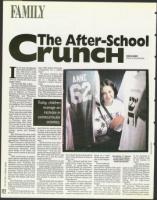
PHOTO BY GLENN TRIEST
Today, children
manage an
increase in
extracurricular
activities.
know their limits and should be
part of the decision of what to
leave out."
Mrs. Littman and her hus-
band, Larry, share the respon-
sibility of supervising the
activities Sarah, 14, and Anne,
11, have chosen. Mr. Littman is
committed to sports and has
charge of the soccer and basket-
ball. But he also takes his turn
driving to Hebrew classes and
dance lessons.
Dividing up the driving with
your spouse or other families
helps a lot, says Mrs. Littman.
She often tells her girls, "If so-
and-so joins, you can, too."
All invitations, activities and
carpool arrangements are en-
tered on a desk Anne Littman, 11, balances is too stressed or
blotter-type calen-
has a conflict, I talk
an after-school schedule
dar on the refriger-
including Hebrew school,
to the teacher or
ator.
sports and homework.
coach."
Since academics
Sometimes at the
are a top priority,
outset, the Littanans
the Littman children often start agree to something only on a tri-
their homework in the car when al basis. Sarah, for example, has
they're picked up from Cranbrook been asked to help teach Hebrew
Schools. Reading assignments, on Sunday mornings at Congre-
work sheets and flash cards are gation Shir Tikvah in Troy. She's
often done in transit. Then it's a eager to try it, but it may be too
mad dash to claim the comput- taxing with her high-school
er when they do get home after schedule.
lessons.
But one rule is firm, insists
"We insist on attendance at Mrs. Littman. "When you start
Hebrew," says Mrs. Littman, something, you have to finish the
"but other activities we don't session, semester or whatever.
force. In some cases, it's OK to There's no quitting in mid-course.
miss a lesson or practice. If a kid It's important for kids to realize