
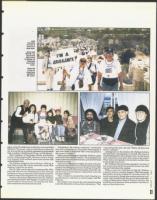

(right)
The Cantors
have been to
Israel over a
dozen times.
(below right)
When Mr. Liss
(second from
right) covered
his stitches, his
friends also
covered their
heads.
(below left)
Family has
always been
important to
Ms. Cantor.
gogue, where his rabbis have invited him to say the Birkat
HaGomel. The prayer, which is recited by an accident vic-
tim, is a way for one to publicly expresses his gratitude to
God, according to Rabbi Daniel Nevins of Adat Shalom.
Marcy Feldman, of Huntington Woods, and Barbara
Cantor, of Farmington Hills, also know what it means
to be thankful. Each suffered closed-head injuries with
cerebral blood clots.
Ms. Feldman slipped on the ice during a 1994 trip to
New York; in June, Ms. Cantor was hit by a truck while
walking a mile from her home.
Feb. 10, 1994, was the day that transformed Ms. Feld-
man's life. She was on a business trip in New York and
had plans to stay an extra day. She wanted to look for
a dress to wear to her daughter's bat mitzvah ceremony.
Outside a Manhattan department store, Ms. Feldman
was crossing the street. She slipped on a patch of ice, hit-
ting her head on the pavement. The next day, Ms. Feld-
man would learn she fractured her skull.
"God blinked," Ms. Feldman explained. "I always feel
that God is watching me. During the whole episode, I
was never afraid. I remember when I was lying there; I
felt a sense of comfort."
After a group of strangers helped Ms. Feldman, police
insisted she seek medical attention. The hospital put her
under observation for several hours, and she flew home
later that evening.
Dizzy and unable to see straight, she went to the doc-
tor the next day. A CAT scan revealed a fractured skull,
cerebral hemorrhaging and brain swelling, forcing Ms.
Feldman to spend the next three months in bed. She val-
ued her time at home because it allowed her to be with
her three children.
"Now, I really try and prioritize what's important in
my life because I only have so much energy," said Ms.
Feldman.
Her children have become the most important thing
in her life, followed by work and then volunteering. "That
wasn't always the case," she said. "Before, all three were
my No. 1 priority."
Looking back on the accident, Ms. Feldman believes
she received a warning prior to her fall. She was in a
crowded department-store elevator when "an old woman
with watery blue eyes said, 'Don't step on the street.'
There were a lot of people in the elevator and she chose
to stand right next to me."
Ms. Feldman discounted the stranger's warning. It
was a snowy day and she assumed the woman was mak-
ing small talk about the weather.
Today, a year and a half after her fall, Ms. Feldman
is back at work as a jewelry designer. With less energy
than before, she has curtailed her activities within the
Jewish community, though she remains active as a vol-
unteer with Jewish Family Service and the Jewish Fed-
eration of Metropolitan Detroit Women's Division. She
would like to do more but she just doesn't have the en-
ergy and that bothers her.