

STUDIO
330
• Fine china, fine crystal and
interesting gifts
• 20% off most of your favorite
brands
• Computerized bridal registry
• Free gift wrapping
Mon.-Sat. 10-6 ; Thurs. 'til 8
Bloomfield Plaza • 6566 Telegraph Road at Maple • Bloomfield Hills
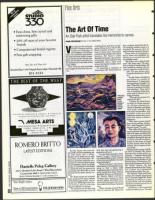
The Art Of Time
An Oak Park artist translates his memories to canvas.
FRANK PROVENZANO SPECIAL TO THE JEWISH NEWS
an Gogh had the orchards
of Arles. Gauguin had the
myths and symbolism of
the Tahitians. And Morris
Rosin has his father's gas station,
far removed from today's imper-
sonal "pump and go" service mar-
kets, but as clear and distinct in
his memory as it was back in the
early 1920s.
Now, if he can just translate
the images of his youth onto can-
vas.
If
851-5533
POTTERY • PAINTINGS • JEWELRY • FURNITURE
UNIQUE ACCESSORIES FOR THE HOME
32800 FRANKLIN ROAD • FRANKLIN, MI 48025
TUESDAY - FRIDAY I0 A.M. - 5 PM.
SATURDAY: II A.M. - 5 P.M.
(810) 851-9949
ROMERO BRI'll
p nrr. IFVVI SH N EW S
LATEST EDITIONS
Danielle Peleg Gallery
4301 Orchard Lake Road • West Bloomfield
Crosswinds Mall • (8 10) 626 5810
-
Hours: Monday-Saturday 11-5:30, Sunday 12-4
The Bright Idea:
60
Give a Gift Suoscription
THE JEWISH NEWS
ther, a builder, found that the lo-
cal building market came to a
standstill. So, around 1917, he
and his family moved to Detroit.
Those years of attempting to
find a home and establish an
identity in a new land have cast
an indelible mark.
"My father was a determined
man," Mr. Rosin said. "He came
from a family of woodworkers. He
even worked in a factory. But, he
always wanted to work for him-
self. The gas station gave
himself something to build
on.
For Mr. Rosin, his father's
gas station is a symbol of
achievement. "I appreciate
the immigrants' struggle," he
said. "They didn't have social
security or pensions, but they
had ambition. They didn't
rely on anything except char-
acter and an honest way of
doing business.
"Why does
"Through this project, I'm
a person
paint?
reliving my life."
I paint
Yet time, Mr. Rosin knows
because I
too well, is a finite commod-
need to
ity. He has collected hun-
express
dreds of sketches, paintings
myself."
and wood carvings from
more than five decades. And
he prefers to live as a quiet
craftsman rather than as an
artist who wants to make a
statement.
"Why does a person paint?
Some want prestige, recogni-
tion. I paint because I need to
express myself," he said.
The walls of his Oak Park
home he shares with Julia, his
wife of 35 years, are filled with
his impressionistic paintings
completed during his days as
a civilian aircraft mechanic,
living on the base at Pearl
Harbor shortly after the De-
cember 1941 surprise bomb-
ing attack.
During his five years at Hick-
that he's also strengthening a
em Base in Hawaii, Mr. Rosin
generational bond.
"I'm the oldest member of the discovered his initial artistic in-
family," he said. "I think that it's spiration — Oriental culture. His
my responsibility to have a record early vivid paintings are distin-
of who their grandfather was and guished by broad strokes of the
myriad faces of Hawaiians, Fil-
what took place."
'What took place" was yet an- ipinos and Japanese who lived on
other family of immigrants strug- the Pacific islands. He had
gling to find a place amid dreams of traveling to the Orient,
neighborhoods of recently relo- but a career as a commercial
cated people from Italy, Poland, artist beckoned after the war.
His work for Olsen and Cum-
England, France and Germany.
Mr. Rosin's father arrived in mings, the largest advertising
Toronto from Russia in 1904, firm in Hawaii, helped Mr. Rosin
shortly before the failed over- to develop his skills as a com-
throw of the Russian czar and in mercial artist, but the endless
the midst of the Russo-Japanese deadlines hardly bound him to
the corporate world.
war.
"Conditions in the (corporate)
When Canada entered World
War II, however, Mr. Rosin's fa- world can take you in," he said.
neighborhood and the curved-
pump filling station where Mr.
Rosin's family worked — and
lived. In those days, merchants
usually lived upstairs from their
business. Mr. Rosin's initial
sketches illustrate a gas station
and garage where business was
conducted, and a back yard
where the family's clothes were
hung out to dry.
In capturing a remnant of
Americana, Mr. Rosin believes
For Mr. Rosin, who recently
turned 80, art, isn't something you
do with paint and a brush.
Rather, art is what you do with
your time. And these days, Mr.
Rosin's greatest ambition as a
painter is to recreate that bygone
era of simplicity, which, he recalls
fondly, is embodied in the Model
A. Along the way, he expects his
paintings also will offer a vivid
portrait of the Rosin family his-
tory.
Mr. Rosin has set out to sketch
from memory the many details
of his father's gas station, once lo-
cated near McDougal and Gra-
tiot Avenue, about a mile from
Eastern Market in Detroit.
The sketches are the first step
in creating paintings of the old