

The Sophisticated Poet
And Painter From East London
ELIZABETH APPLEBAUM ASSOCIATE EDITOR
D
50%-75% OFF
ALMOST EVERYTHING
CALMAN SHEMI
RECENT WORKS
ays before his death, Isaac
Rosenberg wrote a letter
expressing his confidence
in the future.
"I live in an immense trust
that things will turn out well," he
said.
But things did not turn out
well — not only during Rosen-
berg's life (he died when he was
28 years old) but in the years
that followed. For despite an im-
pressive record of art and poetry,
this painter-poet is virtually
forgotten by all but a handful of
critics.
Paul Fussell, author of The
Great War and Modern Memory,
an analysis of World War I
literature, described Rosenberg's
"Break of Day in the Trenches"
as "the most sophisticated poem
of the war." His paintings hang
in galleries worldwide, including
the Imperial War Museum and
the Tate Gallery in London.
Born in Bristol, England, in
November 1890, Isaac Rosen-
berg was raised in east Lon-
don, the second son of Lithu-
February 5-26, 1995
Meet the artist
Sunday, February 6, 1995, 1-5 p.m.
at a Champagne Reception.
DANIELLE PELEG GALLERY
4301 Orchard Lake Rd., West Bloomfield
Hours: Mon.-Sat. 11-5:30, Sun. 12-4
Tel.: (810) 626-5810
At the Crosswinds Mall
13 A
OPEN EVERY EVENING &
BY SPECIAL APPOINTMENT
.
V
ART
glZ CENTER
Gifts
Arts
From
Around
The
World
92
GIFTS & DECO FOR
EVERY AGE...FIND
SOMETHING EXQUISITE
FOR THAT SOMEONE SPECIAL
U
VALENTINE'S DAY SALE...
SAVE 20% WITH THIS AD
•Bohemian • Polish Crystal
•Hand Blown Glass • and more
6369-A Orchard Lake Rd. • Inside Orchard Mali • West Bloomfield • 810-932.8878
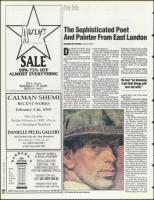
A 1915 self - portrait by Isaac Rosenberg.
anian immigrants.
Anna and Barnett Rosenberg
and their five children lived in a
one-room home in a Jewish
neighborhood, where Barnett
worked as a peddler.
"Poverty," author Ian Parsons
writes in a biography of Isaac
Rosenberg, "was a basic ingredi-
ent of Rosenberg's childhood and
youth, and it not only helped to
mold his character but influenced
his whole life, and more especially
his development as a creative
artist."
At 14, Isaac Rosenberg was
forced to leave school so he could
take work and help support the
family. He became an engraver.
One year later, in 1905, he began
writing poetry, though it was not
until 1912 — when he was 22 —
that he had his first work, Night
and Day, published.
The problem, Ian Parsons be-
lieves, was Rosenberg's "extra-
ordinary compression of language
... he possessed, from very early
on, the complementary gift of
being able to clothe his ideas in
language as original and startling
as his vision. There are few poets
whose work is more impressive-
ly free from the banal epithet and
the dead phrase."
But even before Rosenberg be-
gan writing poetry, he often could
be found drawing on the small
kitchen table in his family's
home.
"I spend most of my time draw-
ing," he told a friend, "I find
writing interferes with drawing
He had "an immense
trust that things will
turn out well."
a good deal, and is far more
exhausting."
Though he continued working
most of the day as an engraver,
Rosenberg managed to enroll first
at the Stepney Green Art School,
then later at the Slade School of
Art in London, where
teachers were impressed by
both his drawings and
paintings.
His tuition was paid for
by three women, includ-
ing Delissa Joseph, the
mother of a young man
Rosenberg tutored. The
first review of his art,
shown at the Baillie Gal-
leries, appeared in the Lon-
don Jewish Chronicle.
Among Rosenberg's fa-
vorite artists were Blake,
Rosetti and Degas, yet his
own style remained intact.
"None of them seems to
have much influenced him
stylistically," Ian Parsons
writes in The Collected
Works of Isaac Rosenberg.
Rosenberg produced a
number of landscapes and
portraits depicting family
members including his sis-
ter, father and brother-in-
law. Using deep strokes
and muted colors, he paint-
ed bridges, the sea, and a
quiet valley with trees.
There are many self-por-
traits; Rosenberg isn't smil-
ing in a one.
By the time he was in
his early 20s, Rosenberg
had won a number of prizes
for his art — including a
First Class Certificate at
the Slade School. He also
had exhibits at the
Whitechapel Art Gallery