

HEAL!
Aesthetic Dermatology
DEDICATION page 19
C
City headquarters just told us
that our Detroit chapter raised
more money (in tributes) than
any other chapter in the country,"
she says.
Overall, the metro Detroit
chapter raises between $750,000
and $800,000 a year. Proceeds go
to research.
Mrs. Collens uses her experi-
ence as a former financial office
administrator to process the hun-
dreds of tributes people make to
the JDF every year.
"The envelopes are all ad-
dressed to me," she says. "A lot of
them come right to my home, and
I pick up the rest at our South-
field office. I have to work on
them every night. Most tributes
are addressed 'in honor of or 'in
memory of.'
Marvin E. Klein, M.D.
Fellow American Academy of Dermatology
Fred M. Novice, M.D.
Fellow American Academy of Dermatology
Phyllis Fine, R.N., CCP
Hair Transplantation and Cosmetic Dermatology
Hair Transplantation
Facial Restorative Programs
GLY DERM.
Collagen Implantation
— Chemical Face Peeling
— Acne Scar Corrective Surgery
Surgical, Medical and Cosmetic Treatment
of the Skin, Hair and Nails
—
Mrs. Collens is closely related to
someone who has the disease.
"My granddaughter has been
diabetic since she was 1 year old,"
Mrs. Collens explains. "She's
going to be 15 now. I hope and
pray that some day they'll find
a cure."
The clinical name for juvenile
diabetes is Type I Diabetes, and
it affects more than 1 million peo-
ple in the United States — peo-
ple of all ages. Type I Diabetes
occurs when the body does not
produce or effectively use insulin.
Insulin is a hormone necessary
for proper metabolism of blood
sugar and for maintenance of the
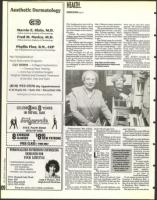
Betty Collens and Rita Haddow
dedicate themselves to raising money
for diabetes research.
there can be very dire conse-
quences." Ms. Haddow explains.
"The consequences can be blind-
ness, kidney failure and even am-
putation of limbs."
The key to avoiding the bad ef-
fects of the disease is regular in-
take of insulin.
"My grandson takes insulin
four times a day," Mrs. Haddow
says. "Four times a day he has to
prick his finger and measure his
blood sugar. The blood sugar
reading at that particular mo-
ment tells him how much insulin
to take."
Mrs. Haddow proudly de-
scribes her grandson as "a big,
strapping 12-year-old.
"He's tall and athletic. On the
outside, you wouldn't be able to
tell that he has this terrible dis-
(810) 932-3376 (By Appointment)
4120 Maple Rd. • Suite 206 • Bloomfield Hills
Participants in Most Insurance Plans
EXERCISE AND AEROBICS
518 E. Fourth Street
(810) 547-6220
INN
EXERCISE $R00
ti CLASSES
or
%, NEW PATRONS
FREE CLASS 1 TIME ONLY
PERSONALIZED NUTRITION COUNSELING
DESIGNED FOR
YOUR LIFESTYLE
• individualized counseling
• permanent weight loss,
low cholesterol,
low sodium, diabetic
• sensible, non-fad approach
1110
7071 Orchard Lake Road
Suite 300
Gail F. Posner, M.S.
West Bloomfield
Registered Dietitian
(810) 855-4558
Bring this ad for a free initial consultation
PHOTO BY GLENN TRIEST
8
CELEBR8ING
YEARS
IN ROYAL OAK
"Unfortunately," Mrs. Collens
says, "the majority of tributes I
get are 'in memory of.' But we do
receive many tributes for wed-
dings, bat mitzvahs and bar mitz-
vahs."
In fact, people can send a trib-
ute in honor of any occasion.
Volunteering with the Juve-
nile Diabetes Foundation takes
up most of Mrs. Collens' day. In
her spare time, though, she vol-
unteers for a different cause.
"I'm chairperson of the Temple
Israel satellite for the Sinai Ser-
vice With Love program," she ex-
plains. "Basically, we have a list
of people who are homebound for
various reasons. The volunteers
call and check in on them every
day.
"I kind of supervise the opera-
tion. Pm on the phone every day
myself to make sure everybody
has been reached. Plus, there are
reports I have to take care of. If
someone is not abe to make the
calls, then I make them from
home."
Like so many Juvenile Dia-
betes Foundation volunteers,
proper blood sugar level.
Symptoms of the disorder in-
clude frequent urination and con-
stant thirst.
Type II Diabetes is the more
common form of the disease. It af-
fects almost 10 million people in
the United States, but it differs
from Type I because it can usu-
ally be controlled
by diet or oral med-
ication.
ike Mrs. Col-
lens, Rita Had-
dow, one of the
vice presidents of
the metro Detroit
JDF, connects with
the organization
for personal rea-
sons.
"My 12-year-old
grandson became a
diabetic when he
was 9. When I found out, I just
had to do everything I could," she
says. "And JDF is in the very fore-
front of raising money for re-
search."
"With juvenile diabetes, even
though you are taking insulin
ease," she says.
And that's the most difficult
part of raising funds for juvenile
diabetes research, Mrs. Haddow
says.
"(Although) juvenile diabetics
look healthy on the outside, many
people don't understand the ter-
rible consequences of this disease.
With multiple scle-
rosis or muscular
*. ........
dystrophy, you see
........ • • •
the physical signs
of the disease. With
juvenile diabetes,
you don't."
To raise funds,
she explains, "you
do everything. You
call people up, you
make appoint-
ments to see them
— you have to
touch their hearts."
Fund-raisers include the JDF
Evening of Brilliance Ball, a
black-tie event which will be held
May 20 at the Ritz Carlton Hotel
in Dearborn. Mrs. Haddow is
cochairing the event.
She says one of the main forces