

Close Up
•
rihi. A
tro, r: t
'841
JUANA C
tin
'14
al
': 11 t rA 4
'
their way back into the ruins. Many were screaming.
Huge blocks of stone continued to fall; no one will ever
know how many people were killed instantly, how many
killed by falling stone, how many suffocated waiting for
rescue. The scene was one of hellish confusion.
"The television cameras arrived in five minutes; the
police and ambulance took 15," Mr. Slutsky recalled. His
deepest concern at the time was to let his family know he
was all right, before they saw the pictures on TV. He
grabbed the microphone a radio reporter stuck in his face
and begged for someone, anyone, to call his mother and
tell her.
A neighbor heard and phoned at once with the news;
his mother ran to find Pablo. But it was too late. The
little boy was sitting in a back room in front of the tele-
vision, crying.
Mr. Slutsky stayed at the site, assisting rescuers, till
5 am. the next day. He slept at a nearby building, then
returned. A sturdily built man in his early 30s, he worked
diligently, tirelessly, almost without thought. A friend
begged him to identify her husband's body; he walked
into the room filled with bodies — and parts of bodies
— pulled from the wreckage, and did so. "If you ask me
if I could do such a thing, I would say, no, never," he said,
speaking through an interpreter. Yet he had.
It would be two weeks before he saw his family again.
When he did, his mother insisted he remove every strip
of his clothing, so she could see for herself the impossible
truth: he had received not a single scratch.
But not even the seemingly untouched came away un-
scathed. Nearly four months after that July 18 morning
when a bomb ripped through the AMIA building, killing
86, wounding 200, even those who survived intact are
struggling to recover, reeling under the weight of
unbearable pain, groping for answers in a country where
truth and justice, hard facts and real solutions are all
elusive commodities.
According to Argentine police, a white van drove into
the entrance of the building and exploded; intelligence
sources place the blame on Iranian fundamentalist ter-
rorists. An investigation, headed by a judge, is under way.
But this is a country where almost nobody trusts the
police, the intelligence service, or the official version of
anything. The bombing of the Israeli Embassy here two
years ago remains unsolved. No one believes the current
investigation will come to anything, either.
They cling instead to private truth. Everyone here has
a story about "the moment," 9:53 a.m., if not their own,
one they have heard. There are the close calls. Asiram
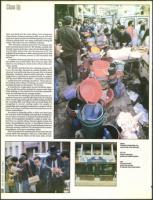
Above:
Volunteers flooded the area
near the site in the aftermath.
Far Left
A line of volunteers
passes out needed supplies.
Left
Concrete barriers
protect the entrance
to Hebralca Community Center.