

mazimemeasamaimzmismummozwanszgatum,
.
Ts ~
Event Benefits
Psychoanalysis
113 ecades ago, when Dr. Melvin
Bornstein specialized in psychi-
atry, he became an expert on the
human brain, but something
was missing.
"The mind was too compli-
cated," he says. "I couldn't fully
understand what my patients were telling
me and why they weren't getting better."
Day to day, Dr. Bornstein treated people
with thwarted potential, intense anger, mar-
ital problems and anxieties neither they nor
he could completely comprehend. Dr. Born-
stein says he found a clear road map to their
wellness in psychoanalysis, the theory of
human psychology founded by Sigmund
Freud.
Committed to learning more about psy-
choanalysis, Dr. Bornstein in the early
1970s entered the Michigan Psychoanalyt-
ic Institute and spent the next eight years
RUTH LITTMANN
STAFF WRITER
alysts also offer help to children, teen-agers
and adults in Oakland, Wayne, Macomb
and Washtenaw counties.
A privately-funded, nonprofit, nonsec-
tarian organization, MPI was founded in
1957. On Saturday evening, Nov. 19, at the
Westin Hotel in Detroit, MPI will sponsor
a benefit featuring Broadway star Barbara
Cook. Proceeds will go toward MPI's oper-
ations.
"We feel that, while needs continue to
grow, resources to provide care continue to
diminish," says Dr. Deanna Holtzman, MPI
president.
In 1980, MPI recorded a total of 3,123 pa-
tient hours in its treatment clinic. That dou-
bled by 1990, and increased again this year.
MPI leaders attribute the rise partly to a
recent decline in government funding and
restrictions in insurance coverage which,
they say, have "effectively denied quality
"Needs continue to grow."
— Dr. Deanna Holtzman
0 KNIGHT PHOT
CD
0
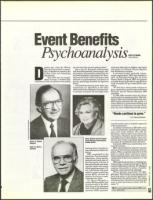
Above, Dr. Marvin
Margolis.
Right, Dr. Melvin
Bomstein
Above: Barbara Cook will appear
for the Michigan Psychoanalytic
Institute benefit.
learning about ways the hu-
man subconscious affects be-
havior.
MPI, accredited by the
American Psychoanalytic
Association, trains psycho-
analysts and each year of-
fers thousands of hours of
free and reduced-rate treat-
ment for people who cannot
afford psychoanalysis. Of-
ten, individuals with mod-
erate to severe conditions
access MPI's services for
three to five hours a week,
sometimes for years.
Dr. Marvin Margolis, a
former MPI president and
president-elect of the APA,
says many of his colleagues
have worked with Holocaust
survivors. MPI's
mental health care to sizeable segments
of the community."
In addition to treatment, MPI offers class-
es for psychiatrists, psychologists, physi-
cians and social workers who, like Dr.
Bornstein, want to learn more about psy-
choanalysis. Students spend between six
and eight years on their studies. Upon com-
pletion, they receive a graduate degree and
can apply for certification from the APA.
Currently, MPI has a membership of al-
most 80 analysts.
MPI representatives extend volunteer
services to local schools, businesses and hos-
pitals. Often, corporate executives invite
them to speak about personnel issues.
School administrators enlist their help to
understand behavioral problems in the
classroom.
Although the group has no religious un-
derpinnings, a large percentage of MPI's
current leadership is Jewish. Dr. Margolis
explains this partly in terms of psycho-
analysis' roots and Jewish attitudes.
"Freud, himself, was Jewish," Dr. Mar-
golis says. "But I think it's also because Jews
have been active in the mental health pro-
fessions from the earliest years. The values
of Judaism have oriented us to trying to find
ways to alleviate human misery and dis-
tress." ❑
IT For more information about MN,
(810) 5595855.
Cr)
CS)
03
U....1
UJ
55