

0
lion of participants' family backgrounds.
They talk about their expectations of mar-
riage, and group leaders emphasize skills
of good communication.
"It promotes discussion of important is-
sues — issues couples often delay talking
about," Ms. Lerner says. "How are we
going to organize our finances? Do we set
up different bank accounts? Do we have
goals, long-term, short-term and middle-
term?
"All of these issues are normal. They be-
come problems when couples don't talk
about them from the start," she says.
Couples are asked to reflect on: What
kind of a marriage did your parents have?
What kind of relationship do you think
you had with your mother (father)? To
whom did you go for emotional support?
"People who answer these questions get
a better idea of whom they're modeling
themselves after in their family," Ms.
Lerner says.
Although members of the group are en-
couraged to discuss their backgrounds, no
one is expected to divulge private infor-
mation.
"We have boundaries," she says. "I want
the group to feel comfortable."
Sometimes, albeit rarely, it is obvious
that a couple doesn't click. Ms. Lerner re-
members a young man and woman who
cast an awkward shadow over their coun-
terparts when they bickered and
refused to listen. The couple com-
pleted all five sessions, but later
broke off their engagement.
"Which is great," Ms. Lerner
says. 'That's what we hope to do.
Through Kiddushin, couples
who really shouldn't get married
weed themselves out. In fact, the
divorce rate might be lower be-
cause some people with problems
they simply can't resolve have de-
cided not to go through with the
marriage," she says.
The more obvious religious
part ofiaddushin comes into play
during the last session when a
rabbi visits the group to talk
about facets of a Jewish house-
hold. Sex, keeping kosher and
bringing rituals into family life
are among the topics highlight-
ed.
"It is through family that a
sense of Jewish identity is passed
along," says Ms. Lerner. "Studies show
that if, by the third generation, (religious
rituals and observances) are not passed
along, they're lost."
ewish rituals must not get lost.
They're far too critical to the health
of a marriage, says Rabbi David Nel-
son at Congregation Beth Shalom.
"Rituals are what I call the poetry of life.
Couples can live without ritual, but how
much poorer will they be for it? It adds a
whole new spiritual dimension to their
lives," he says.
Rabbi Nelson draws from personal ex-
perience. He remembers the Iqddush cup
he and his wife, Alicia, received' and used
on their wedding day. That cup served as
a symbol of their unity on every Shabbat
— that is, until the Nelsons•children
and needed a larger one. -
"It is a custom of sharing," he says.
Shomer Shabbat Jews often refer to the
day as a respite from frustrations of the
hectic work week, and better still, as a time
to reacquaint themselves with family. The
dinner table, says Rabbi Nelson, can serve
as a forum for discussion, as a time of
bonding for husband, wife and children.
Rabbi Nelson, during the four-and-a-
half month conversion class he leads, re-
quires engaged couples to write about their
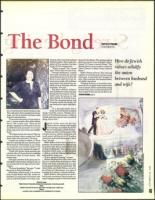
Opposite page:
Rabbi Herbert Yoskowitz stresses the importance of knowing oneself.
Right:
Judaism has built-1n laws to help make marriage work, rabbis say.
Above:
Lorraine Lemer coordinates JFS's Kiddushin Is For Keeps.
RUTH LITTMANN
STAFF WRITER
plans for the future. The partner who is
about to convert must elucidate "How I
Intend To Create a Jewish Home." The
Jewish partner must complete a paper on
"How I Choose To Help Create a Jewish
Home."
Rabbi Nelson believes that striving
together toward this goal nurtures warm
memories. A mezuzah isn't enough, he
says. Other practices, like keeping kosher,
are highly important.
"Keeping kosher is a beautiful state-
ment about a couple's home and the fact
that all people will be comfortable eating
in their home. But a couple should not be
discouraged if they are not yet able to ob-
STRENGTHENING page 50
How do Jewish
values solidify
the union
between husband
and wife?