
A
•
`:*
Unconditional
Love
Societal changes
alter the roles
of grandparents.
1
n the typical Jewish
family of years ago,
grandparents often
lived in the same neigh-
borhood as their
married children,
sometimes even in the same
house.
Zayde retained his honored
place as head of the family and
Bubbie could usually be found in
the kitchen, readying the chick-
en soup and fresh-baked challah
for Friday night dinner.
Fast forward about 50 years.
Factor in the rising number of
interfaith marriages, the high
rate of divorce and subsequent
remarriages, and the number of
families (and grandparents)
moving across the country for bet-
ter career or retirement oppor-
tunities. The picture has changed
dramatically for the entire fami-
ly, and grandparents are no
exception.
Today's grandparents face
challenges for which they had no
preparation, and many feel
caught between two worlds which
have no common ground.
Sandy Schwartz, the Grand-
parenting Program coordinator
for the Merrill-Palmer Institute
of Wayne State University, pro-
vides many grandparents with
the guidance they need to cope
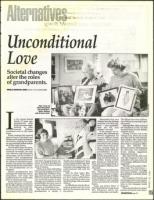
PHOTOS BY GL ENN TRIEST
RONELLE ROSENTHAL GRIER SPECIAL TO THE JEWISH NEWS
Right: Sonia and
Arthur Sklar admire
their grandchilren.
Below: Making a
point to keep in touch.
"Remember that your
children have the ultimate
authority over their chil-
dren — your grandchil-
dren are not your
children," she said.
If the parents are re-
ceptive, Mrs. Schwartz has
several suggestions for
ways to interject Jewish
tradition. These include
talking to grandchildren
about their roots, relating
family stories and memo-
ries, inviting them for
Shabbat dinner, taking the
grandchildren to syna-
gogue, involving them in
holiday preparations, vis-
iting a Jewish book fair or
exhibit, buying Jewish
with their changing family situ- "healthy dose of diplomacy" when gifts, passing on a family heir-
ations. Interfaith grandparent- trying to bring Judaism into their loom, and encouraging them to
ing is one of the most prevalent grandchildren's lives. She rec- read biographies of famous Jew-
areas of concern.
ommends a non judgmental, non- ish people.
Of the more than half-million confrontational talk with the
For out-of-town grandparents,
intermarried couples, one-fourth parents.
Mrs. Schwartz recommends
are raising their children as Jews,
"Ask for their help," Mrs. mailing Jewish books or tapes,
Mrs. Schwartz said. This can be Schwartz advises. "Tell them sending a care package of holiday
difficult for Jewish grandparents you don't want to offend them, treats, telephoning on the various
who would like to pass on their but you would like to share your Jewish holidays, and recording
heritage and traditions to their Jewish heritage with your grand- stories and memories of family
grandchildren but don't want to children."
history.
create problems with their gen-
As difficult as it may be, she re-
Sonia and Arthur Sklar of
tile sons- or daughters-in-law.
minds grandparents they must West Bloomfield are trying to put
Mrs. Schwartz advises these abide by the ground rules set by Mrs. Schwartz's advice into
grandparents to employ a the parents.
practice within their own family.
The Sklars have four children,
two of whom are married to gen-
tile women.
Although Mrs. Sklar is fond of
her daughters-in-law, she had
concerns about how the children
would be raised.
During a recent visit to the
Chicago area, where one of her
sons lives with his wife and their
three children, Mrs. Sklar had a
talk with her daughter-in-law
about future synagogue affilia-
tion. She followed Mrs.
Schwartz's advice about keeping
the discussion non-confronta-
tional, making suggestions
instead of lecturing.
Mrs. Sklar felt the talk went
well. Her daughter-in-law was
amenable to the idea, but so far
"it (synagogue affiliation) hasn't
happened."
"You have to be positive," Mrs.
Sklar said. "You never know —
it may work out well. I'm happy
that I have healthy, wonderful
grandchildren, and that's what's
important."
The frequency of divorce and
remarriage leaves many grand-
parents feeling uncertain of their
roles in the changing family
structure.
When parents divorce, grand-
parents can become more impor-
UNCONDITIONAL page 116
C)
0,
Scanned image of the page. Keyboard directions: use + to zoom in, - to zoom out, arrow keys to pan inside the viewer.
August 26, 1994 - Image 135
- Resource type:
- Text
- Publication:
- The Detroit Jewish News, 1994-08-26
Disclaimer: Computer generated plain text may have errors. Read more about this.