

"One other
change has
occurred: the
subdivision is no
longer exclusively
Jewish."
"Some would play instruments and
we'd sing Jewish songs. There were bon-
fires and swimming. On rainy days, we'd
play auction bridge—never contract—
and a card game called kaluke.
I never spent a summer in the city," he
says proudly.
Part of the reason for the existence of
the Colony and Mt. Pleasant was the fact
that South Haven was an incredibly pop-
ular Jewish destination after the turn of
the century.
At one point, the town had 52 Jewish
resorts (among them: Zipperstein's,
Mendelsohn's, Zlatkin's, Levin's, and Fi-
delman's), two Jewish butchers, two Jew-
ish grocers, a synagogue (First Hebrew
Congregation, which still exists), and
"the Corner."
Ms. Germaine claims that at one point
South Haven was "packed with Jews be-
dish culture, the Colony had no appeal
to me. It was for people from the old coun-
try."
The Colony was used as a commune
during the 1960s ("There was a lot of
dope smoking over there," Mr. Shochet
says) and later it became a tennis camp.
It is now unused.
Mt. Pleasant survived the death of its
neighbor, the Colony, and the movement
of its families from the cities to the sub-
urbs. In 1955, the subdivision installed
an elevator from the top of the cliff down
to Lake Michigan, to allow its aging
founders to make use of the beach.
During the height of the move to the
suburbs, life was a little quieter at Mt.
Pleasant — "A lot of houses stood emp-
ty then," Mr. Wretzky says. Then in the
1970s, interest was rekindled as the
grandchildren of the founders began re-
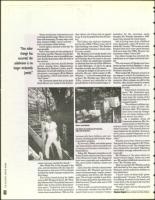
Above: Jerry Wretsky
Left: Where the mailboxes still read Katz,
Segal and Zuckerman.
cause everyone wanted that beach."
After World War II, life changed in the
area. Jewish families left the cities for
the greenery and quiet of the suburbs
and lost the need to escape to places like
the Colony.
The Colony closed during the 1960s
even as Mt. Pleasant lived on. Mr. Wret-
zky believes the Colony failed because it
didn't cater to him and his third-gener-
ation peers. "It died out with its mem-
bers," he says. "Every later generation
wants more assimilation. With its Yid-
turning with their children, and new-
comers, including gentile families, began
to purchase property.
By the early 1980s, real-estate prices
rose dramatically, which coincided with
a boating and tourism renaissance in
South Haven.
Today, Mt. Pleasant resembles an af-
fluent Jewish suburb more than a camp
of the Workmen's Circle. The cottages all
have been expanded and embellished.
The cars include Cadillacs, Saabs and
BMWs.
Like suburban Jewish communities
everywhere, Mt. Pleasant now has its
share of intermarriage, wealth, materi-
al abundance and divorce. Mr. Shochet
says, "It's no longer socialist in any form.
The younger generation has taken over.
Kids have cars. There's cable and a VCR
in every home."
There is still a women's luncheon and
a community calendar, but the Work-
men's Circle is now a memory. Using a
metaphor for the enormous social
changes, Mr. Wretzky describes a 1985
storm that altered the whole beach.
"All of the big trees of my childhood
were destroyed, trees I'd known my
whole life," he says. "We've seen so many
families that have come apart because
of divorce since the 1980s. Divorce was
uncommon when I was a kid."
One other change has occurred: the
subdivision is no longer exclusively Jew-
ish.
"The vice mayor of Chicago now has a
house up here and he's Hispanic," a long-
time resident says, with a mixture of am-
bivalence and pride.
What makes Mt. Pleasant unusual is
the degree to which the residents con-
tinue to carry on the experiences of their
ancestors. Most cottages are still in the
families, often jointly owned by several
great-grandchildren of a
founder.
"I don't know everyone any-
more," Ms. Germaine says.
"But to me, the houses will al-
ways keep the names of the
original family, even if they've
changed hands."
"The children's children con-
tinue to come up here," Mr.
Shochet adds. "Four genera-
tions have used my cottage.
I've cut these bushes every
year since I was a boy."
As a neighbor drops of
homemade preserves, Ms. Ger-
maine points out that five gen-
erations of her family have slept in her
father's cottage. "The parents have al-
ways looked out for the kids. You know,
we've never needed lifeguards at the
beach because people look out for one an-
other."
Seventy years later, there is a sense
that much time has passed at Mt. Pleas-
ant. The trees are tall. The cottages have
been extensively renovated. Vegetation
has broken through sidewalks now 30
years old.
Mt. Pleasant is "the place where my
family history begins, where my roots
are. My earliest childhood memories are
here," Mr. Wretzky says.
After he married, Mr. Wretzky and his
wife decided to live year-round at Mt.
Pleasant, and he raised his children in
the subdivision.
"I know some of these kids' great-
grandparents," he says. "I'm currently
re-building the stairs to the beach, and
I want them to be as close to the way they
were when I was a kid.
"People scatter, but my old gang still
comes back." ❑
Stephen Sagner is a writer in Ann Arbor.