

cause of its close relationship with the
Workmen's Circle and its resort, the
Colony.
Lifelong summer residents believe the
Workmen's Circle brought an air of co-
operative, left-wing Judaism to the sub-
division. One member recalls that "it got
so socialist in the 1930s that they
wouldn't fly the Jewish (later Israeli) or
the American flag." Another says that
"most of the original members were so-
cialists or Bund members back in Eu-
rope. During World War II, we got into
Bond drives and other patriotic things.
There was even a Russian relief party,
and (U.S. Socialist Party founder) Nor-
man Thomas spoke here."
The Colony also provided a Jewish cul-
tural presence on the shores of Lake
Michigan: Yiddish music, theater and
book clubs, communal meals, bonfires,
group sings and softball games.
"There were extremely talented peo-
ple at the camp — Shendel Kalish, a well-
known radio soap-opera actress in the
1940s, and Shimon Rabinowitz, who was
the head of one of the major Jewish-
American organizations," Mr. Shochet
says.
Sophie Germaine cites similar "touch-
es with greatness."
"We've had our share of famous peo-
ple — Michael Filoman,
Aaron Ruben, Henry
Sharp, all Hollywood writ-
ers and producers, and
Leo Rosten, the author of
The Joys of Yiddish, used
to come here as a child,
too."
The first generation re-
flected the working-class
roots of American Jewry:
plumbers, carpenters,
painters, tailors, factory
workers, storekeepers,
salesmen. Escaping the
summer heat, families
originally took trains or
boats (Mr. Shochet re-
members shipboard gam-
bling that lasted into the 1960s). Until
the completion of the interstate high-
ways, driving to South Haven could be a
six- to eight-hour ordeal.
"In the 1920s, there were only dirt
roads," Ms. Germaine says. Ultimately,
what brought them to the Mt. Pleasant
subdivision was not political idealism but
relief from the heat.
"Everything was social. It was before
TV and air conditioning, and most of us
lived in stifling apartments," says Sophie
Germaine's son, Jerry Wretzky.
From the 1920s through the 1960s,
families came to Mt. Pleasant shortly af-
.
ter the end of the public school year and
stayed until Labor Day. Wives and chil-
dren were there all summer. Husbands
commuted on the weekends.
Before World War II, few cars were
available during the week and, as a re-
sult, Mt. Pleasant relied heavily on "the
Store," a small grocery in the subdivision
that closed in 1977.
The gathering of household essentials
reflected much of the way life was lived
in the early part of the century: an ice
man went from house to house; a local
baker took orders; milk was delivered di-
rectly to the doorstep; area farmers vis-
ited Mt. Pleasant and sold produce from
their carts.
Mr. Shochet remembers that his moth-
er only bought meat during the week-
ends — when his father could drive her
into town.
Life in the subdivision was simple. For
many years, there were no televisions,
washing machines or furnaces, and the
only phone was in "the Store."
Surprisingly, the women preferred this
surfeit of modern conveniences.
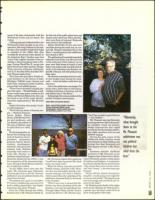
Right: Milton and Rochelle Shochet
Below: Jocelyn McCoy (Sophie's daughter),
Stefanie Roznowski (Sophie's great-
granddaughter), Sophie Lipshutr Germaine
and Dick McCoy (Sophie's son-in-law).
"And they wouldn't speak Hebrew
— only Yiddish."
Mt. Pleasant also had Saturday
morning services (which the social-
ist members would not attend),
bridge tournaments that raised
money for Jewish charities and Fri-
day night campfires with tea and
Hebrew singing.
During the polio scares of the
1940s and 1950s, families would
stay through the High Holidays and
conduct their Rosh Hashanah and
Yom Kippur services at Mt. Pleas-
ant.
Residents describe childhood
summers at Mt. Pleasant as the
happiest days of their lives: softball,
Ms. Germaine explains that appliances trips to the beach, picnics, rowdy games
"would have been too much like 'back of cowboys and Indians. A community
bus drove to South Haven several times
home,' too much work."
While the Colony next door provided a day where there were movies, stores,
Yiddish culture, adult life at Mt. Pleas- and "the Corner," a favorite teen-age
ant also was thoroughly Jewish. Com- hangout.
Jocelyn McCoy, Sophie Germaine's
munity meetings were held in Yiddish,
which assured that the leadership of the daughter, recalls going every night for
subdivision remained firmly in the hands ice cream and pinball. "We played cards
and mah-jongg and socialized and lis-
of the founders.
'When I was a boy, it seemed that Mr. tened to the radio."
Mr. Shochet speaks fondly of his nights
Tankus was always president (of the sub-
division). I always thought Roosevelt, at the budke (Russian for "little house"),
(Chicago) Mayor Kelly, and Mr. Tankus a gazebo near the beach where 30 to 40
would last forever," Mr. Shochet says. teens would gather after dark.
"Ultimately,
what brought
them to the
Mt. Pleasant
subdivision was
not political
idealism but
relief from the
heat."