

S a n s
Si o
SUZANNE CHESSLER
SPECIAL TO THE JEWISH NEWS
Love, a son
and maturity
have moved
Ad Garfunkel beyond
the 'Simon and Garfunkel' era.
rt Garfunkel, long
publicized for his on-
again/off-again mu-
sical association
with Paul Simon,
is bringing an-
other partner to
this season's
concerts—Kathryn Cermak, his
wife of five years.
She will be singing in her hus-
band's show Saturday, Aug 6, at
the Meadow Brook Music Festi-
val.
"I'm certainly going to do Si-
mon and Garfunkel hits because
I love them and so does the au-
dience, and then I'll be doing hits
I've had on my own," said the 50-
year-old singer and actor.
Planning to perform "Bridge
Over Troubled Waters" and
"Scarborough Fair," the four-time
Grammy winner also will feature
selections from eight albums he
has recorded predominantly as a
soloist, as well as some surprise
numbers written by composers
he admires.
Recalling long-ago perfor-
mances at Cobo Hall, he will put
Motown sounds into the program
as well.
"I'm the same artist I always
was," asserted Mr. Garfunkel
about his career with or without
Paul Simon. "I'm in it for the
art's sake, and I try to touch the
universal things that are in all of
our hearts, minds and question-
ing souls. I try to do lyrics that
are thoughtful and poignant and
make everybody feel that we're
all part of the same family of hu-
man beings.
"It works particularly well
when I touch the fears that we all
share—the things that we're
afraid to talk about. To me, that's
when the artist is most potent as
he gives a voice and description
to our doubts. In that moment,
we 'realize that our own, un-
nameable fears are universal."
Mr. Garfunkel describes an on-
stage style that evolved apart
from the man with whom he
shared so many hits in the '60s.
"My personality comes out
more when I'm performing with-
out Paul Simon," Mr. Garfunkel
revealed. "My whole attitude
changes, and I talk to the audi-
ence much more. I love the elbow
room on stage, and I pace the
show as I want."
More insight into his person-
ality can be found in the song
"Skywriter," which is from his lat-
est album, "Up 'til Now.
"It was written by a friend of
mine, Jimmy Webb," Mr. Gar-
funkel said. He considers the
song biographical. "It's about a
guy who's tired of chasing ghost
letters in the sky. He wants to
come down to earth.
"In the '80s, I was restless and
kind of groundless. I think that
many people can identify with
that. I believe a lot of people in
my generation deferred the ma-
turing process and were left won-
dering if they ever would come
down to earth."
Mr. Garfunkel has enjoyed flip
sides to his music and personal-
ity by appearing in films, the
most recent being Boxing Hele-
na, in which he played a psychi-
atrist, a foil for the main
character, who brutalizes his girl-
friend.
He also has acted in Catch 22
and Carnal Knowledge.
"I love to play counterpoint,"
the singer-turned-actor said. "I
think my sound as a singer is
kind of sweet and tenor-like so I
used to love to play against that
and be the killer in a movie. I
took on Boxing Helena because it
was wonderfully weird. .
"This movie is not about gra-
tuitous violence at all. I don't like
that, and I'm very much against
handguns. The film is an exam-
-
ination of inner madness, which
I believe lurks beneath the sur- •
face in all of us, and I think that's
a worthy exploration.
"I think we know life better
when we examine the difficult
parts. It's like waking up and be-
ing scared by some of the things
going on in your dream life, which
is part of the nature of a human
being."
Mr. Garfunkel had a brighter
awakening when his interest in
music came to light. He was
singing in a synagogue choir at
the time.
"I was raised in a Conservative
Jewish family" in New York, he
He started singing at
age 8 in synagogue.
reminisced. "When I was 8 years
old, I was given a white gown
with a satin collar, and I sang
those wonderful, minor-key
melodies and watched the people
cry in the front rows. I knew I
had some kind of lucky gift.
"It's odd that Jewish kids like
me learn from Hebrew school
how to phonetically pronounce
those prayers, but we don't re-
ally know what we're saying so it
wasn't the meaning of what I was
singing that was moving me. It
was the beauty of the notes and
the melody, and there's a lot of
emotionality in just that."
Mr. Garfunkel, who took time
away from entertainment en-
gagements to study architecture
and earn bachelor's and master's
degrees from Columbia College
in New York, believes that syna-
gogues and churches provide op-
portune places to learn how to
sing because their rooms have
wonderful echoes.
GARFUNKEL page 92
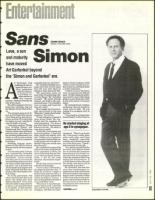
Art Garfunkel: A new life.