

Millions Of Lies
Arnold Shay chronicles the strange story
of a Nazi counterfeit operation.
ELIZABETH APPLEBAUM ASSOCIATE EDITOR
T
he plan was simple.
Putting it into action was
another matter. The goal
was to secure funds for a
war-torn, failing German econo-
my. To succeed, Operation Bern-
hard would require the world's
top printers and engravers, a
gullible Bank of England and a
lot of luck. The Nazis would get
all three.
Arnold Shay, a Florida resi-
dent, owns one of the world's ma-
jor collections of Holocaust
memorabilia. Included in his col-
lection are forged Bank of Eng-
land notes from Operation
Bernhard and rare copies of
sketches of the men who designed
and produced them.
During a recent speech for the
Israel Numismatic Society, Mr.
Shay — who spends summers in
Farmington Hills — told the
strange story of Operation Bern-
hard.
The plan was hatched in 1939,
the brainchild of Reinhard Hey-
drich. Chief architect of the plan
for murdering European Jewry,
Heydrich was looking for a way
to save the German economy,
which was being heavily taxed by
the war effort.
Germany also was eager to
punish British authorities for
printing counter-
feit ration cards
and dropping
them over Ger-
many.
Heydrich's solu-
tion was Operation
Bernhard.
Heinrich
Himmler, in
charge of the "Fi-
nal Solution," took
up the operation,
which was headed
by Bernhard
Krueger, a mem- '
ber of the SS who had made false
passports for German spies dur-
ing World War I. The plan was to
forge millions of Bank of England
notes and trade them for legiti-
mate currency, which would both
undermine the British economy
and boost Germany.
The Nazis began by finding top
engravers and printers — even-
tually, some 140 men — and im-
prisoning them in Barrack 19 at
the Sachsenhausen concentra-
tion camp outside Berlin. Opened
in 1938, Sachsenhausen was the tion," Mr. Shay said.
second-largest concentration
Thanks to Nazi spies and col-
camp during the war.
laborators based throughout Eu-
Mr. Shay, who was in Sach- rope, 15 million of the bills found
senhausen at the time, remem- their way into circulation. Most
bers well the infamous
were 5-, 10- and 20-
barrack.
pound notes (1
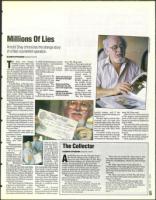
"I can see it now," he (Below left) Arnold Shay
pound
sterling
said. The entire area with some of the forged
equaled
about
near Barrack 19 was notes.
$4.80), though in
inaccessible to other
the middle of the
camp prisoners. "We (Below) Arnold Shay
war, in about 1942,
knew something was and his wife, Eva, with
50-pound notes also
going on over there — some of the forged notes. were produced.
but we didn't know
"Krueger was
(Right)Amold Shay
what."
afraid to print the
with part of his Operation
Work on the coun- Bernhard collection.
50s," Mr. Shay said.
terfeit bills began in
"But the Gestapo
needed money, and if the hard, Mr. Shay said.
Gestapo wanted something, you
After the war, banks learned
better do it."
of the forgery and confiscated
Krueger had a curious rela- some of the notes. Others con-
tionship with the men who tinued to circulate in England as
made the false notes, Mr. Shay late as 1952.
said. The SS leader had himself
The rest of the bills surfaced in
selected them for the project, an Austrian lake, where Nazi
and he saw that they were leaders had dumped all evidence
treated well.
of the crime as the war came to
A number of the men sur- an end.
vived and are still alive, though
Mr. Shay purchased his 35 —
none will speak of their in- some of the few still in existence
volvement in Operation Bern- — from a private collector. [1
1940. In Turkey,
the Nazis discov-
ered rag paper
remarkably sim
ilar to that used
to print British
sterling. The en-
gravers designed
detailed plates,
complete with
watermarks.
Nazi officials had
the counterfeit bills passed
from hand to hand to make
them appear as though they
had been in circulation.
The result, Mr. Shay said,
was more than 200 million
notes that were exact dupli-
cates of the originals. Even
officials at leading banks
were fooled.
"The first set — 5-pound
notes — passed through
Swiss banks and the Bank
of England without ques-
ELIZABETH APPLEBAUM ASSOCIATE EDITOR
gi
mold Shay says he has "the gift of gab."
He has the sharp eye of a collector, too.
Since the end of World War II, Mr. Shay
has been seeking out Holocaust memo-
rabilia, amassing what is today one of the
world's largest collections. Its 10,000 pieces in-
cludes medical instruments used for experi-
ments on prisoners at Auschwitz; letters and
postcards from the death camps; and a Nazi
helmet painted with the owner's war record.
When he's not putting his collection on dis-
play in his home state of Florida, Mr. Shay of-
ten is discussing it.
"I talk of what I know," he says.
Mr. Shay was born in Bendzin, Poland. He
spent the war years in Auschwitz, Sachsen-
hausen and Dachau. He believes he survived in
part because he spoke eight languages, and of-
ten served as a translator.
When the war ended, Mr. Shay went to Dal-
las, where he found work as a tailor. He later
settled in Philadelphia, where his older brother
lived.
Mr. Shay spent most of his adult life in
Philadelphia. Five years ago he moved to Flori-
da, purchasing a second home in Farmington
Hills after he married his wife, Eva, a former
Detroiter.
Mr. Shay, the author of Hell Was My Home,
says he collects Holocaust memorabilia for one
reason: to educate.
"One day I'll meet with these people who
died in the camps, and they'll say, 'What did
you do — you who lived to keep our memory
alive?"' he says. "By not talking about
the Holocaust, we kill them
again." Ll
0)
LU
15