

s And Lives
LESLEY PEARL STAFF WRITER
A Sunday school
program brings
special-needs and
day-school
students
together.
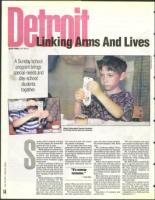
(Above) Akiva student Ylssocher Jerusalem.
(Left) Esther Brodman gets some assistance.
C/)
LLI
Cf)
CC
LU
CD
LU
14
unday school students in Room
16 at the Agency for Jewish Ed-
ucation do a lot in pairs.
They call each other "buddies."
While linking two elementary-
school children together to work
on projects may hardly seem in-
novative, the groupings are
unique in that in most circum-
stances these "buddies" might
never meet.
Of the 11 students in Room 16,
five are first-grade day-school
pupils from Darchei Torah, Hil-
lel Day School and Akiva Day
School. Six are special-needs chil-
dren ranging in age from 6 to 9
years.
Bayla Landsman, coordinator
of special education for the
Agency for Jewish Education, ap-
proached day-school principals
and headmasters with the idea
and asked for suggested students.
Ms. Landsman said she did not
approach day school Yeshiva
Beth Yehudah this year because
she wanted to deal with a limit-
ed number of students.
For six weeks, they have sung
songs about Torah, learned about
honoring parents and preparing
for Shabbat and played on the ag-
ing swingsets outside the South-
field building.
Sarah Kahn, teacher of the
special-needs class and principal
of Darchei Torah, said the chil-
dren have interacted well to-
"It's reverse
inclusion."
—Sarah Kahn
gether. Plans are in the works to
continue the program next year
although a timetable of weeks
has not yet been determined.
"It's important these children
have the opportunity to partici-
pate with other Jewish children.
'e have children who can't
It's reverse inclusion," Ms. Kahn even speak, but they know what
said.
these concepts mean. Repetition
Ms. Landsman added, "There helps them acquire knowledge in
are no opportunities for these spe- a concrete way," Ms. Kahn said.
cific children in day schools. Their
Ms. Landsman believes day-
special needs are greater than school students have the oppor-
mild learning disabilities. And tunity to learn more about
some have developmental dis- disabilities while feeling good
abilities."
about helping out.
Before the program started,
Ms. Kahn holds a masters de-
Ms. Kahn met with day-school gree in special education. Perl
students and gave a brief histo- Fine and Faige Kuperman assist.
ry of each special-needs child. She Ms. Fine recently completed a
explained that the students learn master's degree program in
in a slightly slower, slightly dif- speech pathology.
ferent way.
But the children just seem to
Most activities are hands-on like the warmth and attention
— like making magnets and fin- they receive from the instructors
ger painting. Students span the and each other.
range of levels of observance. Ms.
"I think this is a great way for
Kahn is careful to include every- the children to learn to accept
one. For example, she doesn't just everyone," Ms. Kahn said. "When
say synagogue, but shul and tem- they work and play together, they
ple too.
learn firsthand that a child with
Repetition of concepts and a disability is a child just like
words is key.
themselves." LI