

Turn On The Music
For 30 years,
the Levitts played
some old favorites
throughout Detroit.
Among her 300
records were hits
by Mario Lanza
and Jan Peerce.
elda Levitt's little black book is
filled with such names as
Placido Domingo, Tommy
Dorsey, Nat "King" Cole and
Jan Peerce.
But it's songs, not phone
numbers, listed beside their
names.
For more than 30 years, Mrs.
Levitt and her husband,
Charles, played tape-recorded
dance music at the Oak Park
Community Center and South-
field's McDonnell Towers.
Though since retired, "I'll
play even now if I'm called
upon," Mrs. Levitt says.
She began playing music af-
ter a live orchestra, which reg-
ularly performed at the center,
was canceled. She never re-
ceived any money; she simply
did it for the love of dance.
"When a child is born, I have
always advocated he or she
must have two things in life:
swimming and ballroom danc-
ing," Mrs. Levitt says.
She collected hundreds of
records by the likes of Nat
"King" Cole, Guy Lombardo and
Mario Lanza. Then she and her
husband put the songs on cas-
sette tapes, listing every piece
of music (and the tape on which
it appeared) in a black book that
contains literally thousands of
ELIZABETH APPLEBAUM
ASSOCIATE EDITOR
titles. This way, she could al-
ways know the exact location of
a certain song.
"I had about 300 records," she
says. "I gave them away to
friends."
A Detroit native, Mrs. Levitt
met her husband on a blind
date. He was working in his
parents' store, the Majestic
Farm Dairy, that sold every-
thing from Lipton tea to Kel-
logg's All-Bran. She was a girl
who loved to dance.
"I was 10 years old when I
danced the tango for the first
time," she says. "It was with a
26-year-old fellow.
Her greatest
treasure:
"Zelda," a fan
wrote, "you have
put the gold in my
golden years."
"The last time I won a con-
test I was somewhere near 60,
when I was down in Florida.
"I just turned 84, and I still
love to dance," says
Mrs. Levitt, who has
never had a dance
lesson. "The only
things I can't do (be-
cause of a heart con-
dition) today are the
polka and the cha-
cha."
The grandmoth-
er of four and the
great-grandmother
of one, Mrs. Levitt
says her favorite
dances are the
rumba and lapalo-
ma; her favorite
songs are "Be-
cause," "Trees"
and "Without a
Song."
Music was al-
ways her first
love, but Mrs.
Levitt was active
on other fronts,
as well. During
World War II, as
a member of the
American
c
C.7
N
O
0
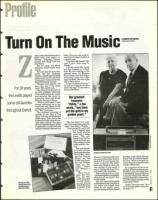
Zelda and Charles Levitt
Women's Voluntary Services,
she wrote letters three times a
week to U.S. servicemen sta-
tioned in Europe. She didn't
know any of those to whom she
was writing; it was simply a
way of letting the boys know
they hadn't been forgotten.
Before sitting down to write,
"I pictured myself in the foxhole,
alone and without family," Mrs.
Levitt recalls.
She also organized busloads
of Detroiters to the Catskills in
the 1950s and helped raise
funds for the Israeli under-
ground during the first years of
the state. In the 1930s, she was
active with the Detroit Equal-
ity Club, which arranged for
coal to be sent to families that
couldn't afford heat.
In recognition of her music-
playing at the community cen-
ter, Mrs. Levitt, who today lives
in Southfield, received the key
to the city of Oak Park. But her
greatest treasure is a letter from
one of the regular dancers at the
community center.
"Zelda," the man wrote, "you
have put the gold in my gold-
en years."
❑