

E terto onion!
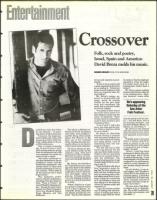
Folk, rock and poetry,
Israel, Spain and America:
David Broza melds his music.
SUZANNE CHESSLER SPECIAL TO THE JEWISH NEWS
avid Broza visits Ann Arbor
for two reasons — to enter-
tain and to conduct seminars.
Tomorrow, the singer-gui-
tarist will be part of the 17th
annual Ann Arbor Folk Fes-
tival, which starts at 6 p.m.
at Hill Auditorium.
Only a couple of months
ago, he was in town to work
with writing students, giving
them his perspective as a folk
rock composer who seeks out
poetry to set to music.
"Ann Arbor audiences re-
ally give themselves to the at-
mosphere I create," said the
Israeli-born entertainer, who
spends about 10 days each
month performing in his na-
tive country. "They make it
all the easier for me to want
to give more."
This weekend's perfor-
mance will give audiences a
sampling from his latest al-
bum, "Time of Trains", his
second English-language pro-
ject. Among the poets repre-
sented are Bette Sussman,
Terry Cox, Elizabeth Bishop,
Tessa Marquis and Dan
McKenzie.
"The album is definitely re-
flective of travel, movement
and hellos and goodbyes,"
said Mr. Broza, whose Israeli
album The Woman by My
Side, one of five recorded
there, remains the most suc-
cessful album in the history
of the Israeli music industry.
"All of my albums are per-
sonal albums as far as the
subjects I pick. They don't
necessarily follow a theme.
They are anything my emo-
tions and mind get attached
to."
Mr. Broza, who moved to
the United States nine years
ago to be closer to the centers
of his favorite music, was in-
troduced to rock 'n' roll in Is-
rael and Spain, where he
grew up. In those countries,
it is very common to turn to
poetry as a lyrical stimulant
for a song.
"What I look for in a lyric
I'm going to compose music
for is a short vignette," re-
vealed Mr. Broza, whose first
two albums included his own
lyrics. "I go by what captures
my eye and captures me per-
sonally.
"It has to have a story and
a great opening line for me to
go on reading it. I direct my
songs toward audiences that
have an acquired taste for
storytelling."
Mr. Broza's unique ap-
proach to writing folk-rock
songs, which he intends
strictly for his own stage
work and recordings, has
made him a seminar leader
at several colleges.
"I've gotten to know a lot of
the poets whose poetry I've
been setting to music over the
years," he explained. "Some
of them teach at universities,
and I've been invited to give
workshops there.
"A lot of rock 'n' roll is the
move, the vibes and the feel,
but I like to look for a little
bit more depth."
Mr. Broza, 37, often finds
himself sharing a program
with discussion leaders who
cover other aspects of writing
and using poetry, such as
translating from one lan-
guage to another.
"I'm the odd one in this
whole bag because I'm the
only one who's really concen-
trated on this in a pop sense
and not an esoteric sense,"
said the performer, who
started playing guitar at age
13 and made his first record-
ing at age 21.
"I get invited to talk about
how I approach a poem, be-
ing that I'm from another art
form, and how I merge my art
into an existing poem with-
out taking away from it, per-
haps changing it somewhat
so it can become a song and
then taking it to the next step
where the masses might get
exposed to it.
"I give the writers another
way of looking into the tech-
niques of writing and what a
reader might look for when
he reads or what he might get
exposed to when he reads.
I'm really much more of a
professional reader than a
writer."
Mr. Broza enjoys reading
historical literature when he
is not reading poetry. Read-
ing, however, comes after
He's appearing
Saturday at the
Ann Arbor
Folk Festival.
time he spends with his fam-
ily — his wife Ruth, who is
his business manager, and
his three children: Moran, 13;
Ramon, 12, and Adam, 4.
Mr. Broza is very pleased
with the sound of his latest
album because he has used a
new approach to his record-
ing.
"I finally came to the point
where I realize I should be
more in control of my own
musical direction with regard
to production and arrange-
ments," he said.
"Before, I used big-name
producers to deliver the prod-
uct and music, which I wrote
as state-of-the-art pop. It was
overproduced a lot of the time
compared to my performance,
which is a very intimate, di-
rect, focused, almost one-man
show.
"In the studios, it was al-
ways bigger, and I decided to
record live in the studio in a
romantic setting. I think this
has made Time of Trains very
warm, intimate and one of
the most romantic of the al-
bums I have done."
The Ann Arbor Folk Festi-
val begins at 6 p.m. Saturday,
Jan. 29, at Hill Auditorium.
For ticket information, call
645-6666. ❑