

B
siness
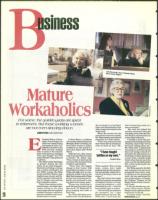
Left: Mira Linder; above: Elizabeth Weiss;
below: Esther Shapiro
Mature
Workaholics
For some, the golden gears are spent
in retirement. But these working women
are not even slowing down.
JENNIFER FINER JEWISH NEWS INTERN
lizabeth Weiss of Hunt-
ington Woods began her
voice-over career during
the heyday of radio. Con-
sidered a pioneer in her
field, she was a leading
lady on some of the most fa-
mous radio dramas, including
"The Lone Ranger" and "The
Green Hornet," both produced
in Detroit.
Ms. Weiss' career first began
to prosper during the late
1940s, an era when being pro-
fessional and being a woman
was a unique combination. By
the 1960s, women like Mira
Linder and Kitty Wagner, both
longtime spa owners, and De-
troit's consumer advocate Es-
ther K. Shapiro were starting
their respective careers.
Today, these mature profes-
sional women, who began their
careers during an era when
most women were not employed
outside of the home, continue to
grace the workforce, with no im-
mediate plans to retire.
Colletta Moser, a professor
who teaches labor economics at
Michigan State University, be-
lieves older women in today's
workforce are the result of a
trend that began after World
War II.
"After the war, older women
were in the labor force for about
a decade," Dr. Moser said.
"Then, women in their late 20s
and early 30s increased their
workforce participation.
"Since then, the biggest
change is that women with
young kids have begun to work.
Today, this adds up to an over-
all growth of older women in the
labor force because each of these
groups has increased partici-
pation and continued to stay
into their more mature years.
"Women are continuing to
work because they enjoy it, just
like men do," Dr. Moser said. "It
gives meaning and order to
their lives."
Ms. Weiss still enjoys a suc-
cessful career. But she believes
she was lucky to avoid hard-
ships and discrimination that
other women have faced in the
work world.
When she moved into the
commercial voice-over market,
Ms. Weiss already had achieved
some fame as a radio actress.
"There was always the bias
that women did not need the in-
come as much as men," Ms.
"I have fought
battles on my own."
Elizabeth Weiss
Weiss recalled. "But over the
years, women have made
progress because they are grow-
ing increasingly intolerant to-
ward the favoring of men over
women."
She said women have made
significant progress succeeding
in business, but she is not con-
vinced her profession — still
dominated by men — will ever
be completely open to women.
"I am not really an activist in
the movement, but I have
fought battles on my own," Ms.
Weiss said. "I have found the
best victories have come on a
one-to-one basis."
She said she helped the
women's movement when she
was doing voice-overs for Gen-
eral Electric industrial films in
a room filled with men.
"I worked on them (the com-
mercials) all morning and when
I finished, I knew they were in
the booth talking about me,"
Ms. Weiss said. "I asked what
was going on, and they told me
they were trying to decide if I
should do the dishwasher and
truck films or if they should use
a man's voice. I scored a small
victory when they let me do the
voice-over for the dishwasher
film, which traditionally was
done by men."
Ms. Weiss stayed in the field
and continues to do one or two
commercial voice-overs a week.
In addition to her commercial
work, she has performed for
area organizations, including
the Readers Theater at the
Maple-Drake Jewish Commu-
nity Center.
In her two decades as a con-
sumer affairs expert, Esther
Shapiro rarely experienced dis-
crimination on the job.
"I've been lucky," said Ms.
WORKAHOUCS page 28