

SPIELBERG'S TRIUMPH
LU
`WE'RE NOT HISTORIANS.
WE'RE STORYTELLERS.'
CRAIG T ERKOWITZ
BEN KINGSLEY, plays Itzhak
Stern, Schindler's Jewish accountant:
CO
0
0
Israel's Holocaust museum, has written
about Holocaust rescuers in general, "leave
us gasping, for we refuse to recognize it as
a natural human attribute. So off we go on
a long search for some hidden motivation,
some extraordinary explanation, for such
peculiar behavior."
Novelist/essayist Cynthia Ozick insists
on gasping. To her, "nothing would have
been easier than for each [rescuer] ... to have
remained a bystander, like all those mil-
lions of their countrymen in the nations of
Europe.... I do not — cannot — believe that
human beings are naturally or intrinsical-
ly altruistic. I do not believe, either, that
they are naturally vicious... The truth...
seems to be somewhere in the middle: Most
people are born bystanders. [Ordinary hu-
mans do] not want to be disturbed by ex-
tremes of any kind — not by risks or
adventures or unusual responsibility."
"What are they if not the
heroes of our battered
world?"
Cynthia Ozick
C/D
w
C/D
w
1—
CD
CC
LLJ
LLJ
44
Of those who undertook risks, Ms. Ozick
asks, "What are they if not the heroes of our
battered world? ... These few are more sub-
stantial than the multitudes from whom
they distinguished themselves; and it is
from... [them] that we can learn the full res-
onance of civilization."
Oskar Schindler himself supplied the
simplest of answers for the deliverance he
offered. In the early 1960s, Moshe Bejski, a
"Schindler Jew" then sitting on Israel's
Supreme Court, finally asked, "Why did you
risk your life for us?"
Schindler answered disarmingly: "If you
would cross the street, and there were a dog
in danger of being run over by a car,
wouldn't you try to help?"
And in 1972, two years before he died,
Schindler attended the 25th wedding an-
niversary of another one of "his Jews."
Aware of Schindler's fondness for cognac,
Murray Pantirer bought him a bottle of the
finest French cognac. He finished it — sin-
gle-handedly — that evening at his host's
home in New Jersey.
"I knew that the influence of liquor helps
the truth come out," remembers Mr. Pan-
tirer. "So I asked Oskar, 'Why did you do it?'
And he said, 'In my young years, I believed
in what Hitler said. We [the German peo-
ple] had got a bum deal [under World War
I's Versailles Treaty]. I was a German in
the Sudetenland, which was taken over by
Czechoslovakia. I was with Hitler until he
started killing innocent people. My stom-
ach turned..."
If enough stomachs had turned, perhaps
there would have been no Krystallnacht, no
Auschwitz, no Treblinka. If enough
stomachs had turned, perhaps there would
have been six million more people alive by
1945. Perhaps there would have been no
war at all. The ways of stomachs — and of
history and goodness — can be fickle, in-
deed. And so is realizing, as Rabbi Laurence
Kushner has written, that the manifesta-
tion of goodness and decency can be
absolutely spontaneous and most surpris-
ing : "... Ordinary people are messengers of
the Most High. They go about their tasks
in holy anonymity. Often, unknown to them-
selves. Yet, if they had not been there,
if they had not said what they said or did
what they did, it would not be the way it
is now. And we would not be the way we are
now...."
Oskar Schindler — charmer, conniver,
schemer — changed his world with unex-
pected goodness. And Steven Spielberg —
Hollywood mogul and the genius behind
such entertainments from "Jaws" to "Juras-
sic Park" — has given us a gift that, given
his past filmmaking record, is almost as un-
expected, and gratefully received. ❑
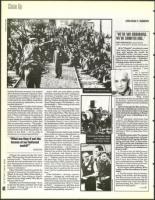
Kingsley in the film (above) and (right.)
Cr)
0
cc
0
2
0
Construction of Schindler's actual
factory (above) in 1944.
Inside the film's "factory "(below).
0
CO
CL.
Q: In "Ghandi," you played a man
who raised the conscience of a na-
tion, and maybe the world. In
"Schindler's List," you play a man
who helps sustain the conscience of
at least one other man — Schindler.
What is your conscience like after
playing people such as this?
A: My conscience is informed by the
people I have met in my life, not by any
character I have
played.
As a portrait
artist, the 'charac-
ter' sits there, my
paints are here,
my canvas is there.
I am not him. I
will give you a por-
trait of him. That
doesn't mean that
I take on board
any morality or
enlightenment...
What would
the questions be like 10 years after I won
an Academy Award for playing Adolf
Eichmann? I didn't, but what would they
be like?
Q: Even though the film had been
gestating in Spielberg's mind for 10
years, does the fact that it was being
made during the slaughters in Bosnia
make it any more compelling or im-
mediate?
A: It's extremely unfortunate that
whilst we were filming, history was prov-
ing to us that it could happen again, that
it will happen again, that it is happening
again... To go beyond that is to make some
very peculiar judgments about our work
and history. We're not historians. We're
storytellers.
Q: Spielberg has said Tm coming
away from the experience jof mak-
ing `Schindler's List'] saying, All these
years, and look what I've been miss-
ing.' That was his way of saying it was
a terrific cinematic and personal ex-
perience. What are you coming away
from it with?
A: I'm not so sure it's right for me to
hope to come away from any film with
anything. What I should do — what I hope
to do — is leave exhausted. It's good at the
end of every day's filming to feel that
you've exhausted every possibility. The
ideal state in which to leave is with noth-
ing because you've given it all away.
Q: You leave with nothing. What
would you like the audience to leave
with?
A: The film treads a fine line between
saying, 'Look at this,' and then saying,
`Feel this and react in this way.' The lat-
ter is manipulative and patronizing; the
former is great work. I hope the audience
will leave saying, 'Yes, I saw it. I saw it.'
That's all we can hope for.
—A.J.M