

SPIELBERG'S TRIUMPH
ch
CC
LLJ
"ONE PERSON CAN
MAKE A DIFFERENCE"
LIAM NEESEN,
0
portrays Oskar Schindler:
LL1
-J
t (t,
-
LLJ
HOLOCAUST MEMO RIAL MUS EUM
C-,
0
CC
IJ-
0
0-
Schindler, the one that moved him from
simply treating his workers with kindness
to actively conspiring against the final so-
lution. If not, then that point surely came
on March 14, 1943, when Schindler's acci-
dental witnessing of the Cracow ghetto's
"liquidation" physically sickened him. The
film's 20-minute depiction of the purge —
shot almost without dialogue, with the si-
lence punctuated only by the gunshots of
the Germans and the cries of the Jews —
is wrenching. It is also a testament to Mr.
Spielberg's craft since it equals — if not
transcends — nearly every other filmic en-
actment of Nazi bestiality.
From the moment he arrived in Cracow,
Schindler masterfully greased the wheels
of Nazi bureaucracy. He carefully placed
bribes — from the sublime (diamonds, cash,
liquor, caviar) to the ridiculous (kitchen-
ware) — while adroitly masking his con-
tempt for the thousand-year reich. This,
plus his mantra that his workers were "es-
sential" to the war effort, gave him a
penumbra of invulnerability:
In 1942, he went to the Cracow train sta-
tion and personally extricated 13 of his
workers from a train bound for a death
camp: "Essential industrial workers, he
muttered. " It's idiocy."
In 1944, when 300 women and children
who worked for Schindler were taken to
Birkenau, he went into that lion's den of
death and brought them to safety: "Irre-
placeable skilled munitions workers," he
bluffed. "Skills I cannot quickly replace."
This is the only known case of specific
individuals released from Birkenau by
name.
Bill of Lading.
Merchandise: Jews.
Theabsolute good" was unavoidably
contaminated by the Nazis' absolute evil.
Their language was as corrupt as their "so-
lutions"; their language was part of their
"solution." Yet, considering who drew up
the list — a playboy, a carouser, a schemer
— this was as it should be: There are few
absolutes in the tale of Oskar Schindler,
for, at its core, his is the story of a man
stumbling into the realm of the good and
the brave and the heroic, with all his faults
still intact, one hand on a bottle of fine
scotch, the other on the key to the closet
where he kept his humanity.
`MY STOMACH TURNED'
VII
e ponder what makes us hu-
man, wonder if Schindler was
"more" than human, and al-
most instinctively reject as "hu-
man" the bestiality of the
Nazis. And yet, to Ralph Fi-
ennes, who plays Amon Goeth, the film's
Nazi commandant, we all encompass the
distance that separates good from evil,
virtue from horror.
"It's a difficult pill to swallow to say that
Nazis were part of humanity," said the
finally: the list In late 1944, orders British actor. "What they did is latent in
came to "relocate" to a death camp human beings... Shooting people from your
Jews from Plaszow, a forced labor balcony [as Mr. Fiennes' character does in
camp — and from Schindler's fac- the film] is only the large edge of the wedge
tory, which was considered a sub- from shooting rats or sparrows or pigeons
camp of Plaszow. Schindler got in your back yard for pleasure if your be-
permission to transfer his factory — and lief is so engrained in you that Jews are on
his workers — to the Czech town of the same lev0 as rats."
Brinnlitz. He compiled a list of 1,300 Jews
In the end; Oskar Schindler's rise to
who would go to the new factory, which he goodness may never be understood. And it
built with his own cash — and which nev- may, as Mordecai Paldiel of Yad Vashem,
F
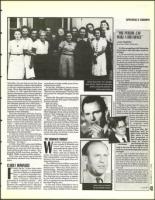
(Above) Some of the "real" Schindler
Jews: German, Polish and Jewish office
workers employed by Schindler in
Cracow enamel factory.
er produced a single usable piece of mu-
nitions for the reich.
In the film, Schindler's Jewish accoun-
tant, Itzhak Stern (Ben Kingsley), muses,
"The list is an absolute good. The list is life.
All around its cramped margins lie the
gulf.
Neither Mr. Keneally's book nor the film
mention that the first page of Schindler's
list bore the title:
F.
CI_OnT HUMANIST
0
U-
0
Neesen (top) as Schindler;
the real Schindler (below).
Q: After grappling with Schindler,
do you have any idea what motivat-
ed him?
A: He was certainly a humanist. I don't
think he was a racist. He grew up with
Jewish children next door and played with
them. He had no feelings of superiority.
He absolutely hated the Nazi regime and
had deep guilt for being a German.
Q: Did you find it daunting to play
a real historical character?
A: I did for a while. I thought initially
that, as an actor under these circum-
stances, you can't use your imagination
because this is how he behaved. But you
have to use your imagination_ and sus-
pend your belief.
Q: Any ideas about how any one of
us would have acted under those cir-
cumstances — as bystander, victim,
persecutor?
A: That's a question we all ask our-
selves, especially because this became a
government policy from the top down. I
certainly would have been very scared,
given my own sensibilities, my own edu-
cation and awareness of being a human
being.
I'd like to think that if I was a very
small cog in the machine — a Jewish cog
or a German cog — I'd have done some-
thing to screw up the works. Because
that's one thing the film makes clear: One
person can make a dif-
ference. And that we all
matter, even though we
live in this bureaucrat-
ic, corporate world
where it's very easy to
pass the buck.
Q: Last May, Mr.
Spielberg said he
didn't want to do the
film when it was
first proposed to
him 10 years ago be-
cause he 'wasn't
psychologically
ma-
Llam Neesen
ture' enough to deal
with it. He was 36. How old are you?
And are you psychologically mature
enough?
A: 41 — and I couldn't have done it 10
years ago. My craft certainly wasn't per-
fected enough by then. I just wouldn't
have been mature enough. But I like the
fact that it was always in the back of
Steven's mind, like a fighter preparing for
some fight that may be two years down
the road.
Steven's experience of the last 20 years
is now like an extra appendage. He's a
great storyteller and has a great sense of
a film's innate rhythm. That's the differ-
ence between a filmmaker and a director
A director directs — 'Put the camera here.'
But Steven always had a cinematic vision.
— A.J.11/1