

Close Op
Play ing
Detroit doctors talk about
what brings people together,
and how to stay that way.
ti p
LESLEY PEARL
STAFF WRITER
home comparing husband/wife
responses to questions like
"Would you marry your spouse
again?," "Is your spouse cruel
to you?" and "Do you find sexu-
al satisfaction within your mar-
riage?"
So far, American responses
are amazingly similar to those
of British couples. In addition,
certain factors — such as chil-
dren, ethnic group, religious
background and socialization
— were common to both Amer-
ican and British couples when
determining satisfaction.
Sometimes couples are ex-
tremely in sync; other times a
husband may respond that he
is extremely sexually satisfied
while the wife has answered
that she is looking elsewhere.
"It's tough to look at a set of
questions sometimes. You know
these people are in trouble, but
there's nothing you can do
about it," Dr. Carol Weisfeld
said. "I think filling out the sur-
vey makes a couple think about
their relationship. We ask cou-
ples to answer the questions
separately, but I hope they talk
about their responses later."
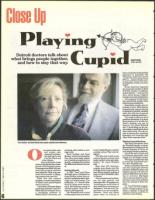
Norm Goldner and Carol Rhodes help couples understand their differences.
T H E DETRO I T J EWIS H N EWS
nce upon a time, men
48
and women met,
married, had fami-
lies and tried to live
a lot like Ward and
June Cleaver.
Now individuals make
money teaching the busy mass-
es how to find and keep a mate.
Newspapers are filled with per-
sonal ads and busy seminars
have titles like "How to be mar-
ried in three months" or "Bring-
ing romance into your life."
Have love and romance
changed, or merely expectations
of them? Local psychologists
want to find out.
University of Detroit Mercy
psychology professor Carol We-
isfeld and her husband Glenn,
a psychology professor at
Wayne State University, are
studying what makes a mar-
riage work.
Norm Goldner and Carol
Rhodes, clinical psychologists
from Troy, have made careers
out of teaching couples how to
identify, understand and utilize
the differences between the sex-
es.
Getting Started
In 1987, Carol and Glenn
Weisfeld spent a sabbatical in
Great Britain where they at-
tended a conference about mar-
riage and relationships. Two
professors of London-Gold-
smith's College were conduct-
ing a 200-question survey of
married couples. They had re-
ceived 1,000 responses.
The Weisfelds were invited
to help analyze data and return
to the United States to conduct
a similar survey. They were de-
lighted.
"The idea was to look at two
cultural groups and see what
might predict universal satis-
faction," Dr. Carol Weisfeld
said.
More than 200 American
couples were chosen and the
multiple choice responses have
been filling stacked cardboard
boxes in Carol Weisfeld's office
in Detroit.
Two questionnaire booklets,
one for each partner and
crammed with 176 questions on
"everything we could think of
that would have an impact on
satisfaction," were sent out. For-
mal data is not yet available.
However, Carol and Glenn
spend many an evening at
Making Generalizations
The study has grown since
the Weisfelds became involved.
Researchers in Turkey and the
People's Republic of China are
now asking similar questions.
Data from each country will
be analyzed separately, then
looked at in the larger context.
"We hope to publish this data
so it may be of practical use,"
Dr. Carol Weisfeld said.
So far, researchers know for
sure that marriages between
partners of different ethnic and
religious groups will have ad-
ditional difficulties and obsta-
cles to overcome. Marriages
where only one partner is Jew-
ish seem to have more problems
than the mixing of other reli-
gions.
Dr. Carol Weisfeld suggest-
ed the cultural aspects of Ju-
daism, in addition to the purely
religious beliefs, could be at-
tributed to this finding.