

REMEMBRANCE page 1
the war. In Washington last
week, she immediately noticed
"Every day and every night
barbed wire around the lights
for six months, I smelled the
in the elevator.
burning human flesh," Mrs.
"It was dark and gray," she
Wohl said.
said. "The doors banged closed.
Last week's day trip, spon-
This set the tone for the whole
sored by Akiva Hebrew Day
museum."
School and CHAIM (Children
Once the doors slammed
of Holocaust Survivors Associ-
shut, the packed elevator grew
ation in Michigan), was the first
silent with all eyes focused on a
Jewish community planned
television screen airing footage
charter to successfully make it
from a scene at a death camp.
to Washington since the muse-
um opened last summer. Tem-
ple Israel officials twice canceled
These photos could
tours because of airplane me-
be of anyone's family.
chanical problems.
"It went without a hitch, and
They could be happy
it went on schedule," said Aki-
va Executive Director Barry
photography-
Eisenberg."The day was an ex-
But they are not.
cellent experience.
"The American people will
learn from this museum, and
Its destination was the muse-
they will no lrvager SAY it did not
urn fourth floor: 1933 - 1939.
happen, – Mr. Eisenberg said.
On the fourth floor, visitors
The tour opened old wounds
saw how varied groups of peo-
for the 20 Detroit survivors vis-
ple, primarily Jews, but also
iting the memorial for the first
Gypsies, Poles, Jehovah's Wit-
time. And it brought tears and
nesses, dissidents and homo-
sadness to three generations of
sexuals, were systematically-
Detroiters — survivors, their
excluded from society in Nazi
children and grandchidlren.
Germany.
"I'm there again," Mrs. Wohl
Next, they saw atr' . ' 1)°r-
said, placing her hand over her
trayal of the ,4.,,,e-sponsored
heart, as she walked through
of 1933, followed
book
the museum. "I don't know
exhibit depicting the im-
where 50 years have gone. We
pact of the Nuremberg Laws
live this every day."
that isolated Jews from Ger-
,
—lex'
was
Lola Pines of Soy'
man
society.
recognized a
startled
On the third floor, 1940 to
oews walking in the
1944, visitors were brought
cfz Ghetto in Poland.
"I walked those
stairs," she said.
"You relive all of
those things when
you see it again.
When I'm here, I see
it like it is today.
Not yesterday."
And survivor
Alex Greenberger
was Surprised when
he noticed a large
photo on the wall of
the.late Henry Ko-
mfeld, :a friend and
a stirytvorZWho was
a baker in Detroit.
"NO :
matter
where-- we
or
what we are doing„ A survivor shows money which she used in the ghetto. She
we alWays end up _ I_money-to the museum.
reminiscing al3Out
this,' . expla
face-to-face with life in the ghet-
Hermina Hirsch;` survivor
tos, the mass murder by mobile
from Southfield. :
killing units, deportation and
For all visitors- to the new
the -asSembly line factories of
museum, the tofu- begins in an
death — the killing centers. The
elevator; which Toby Schlussel
exhibit
took visitors from the
said "felt like the inside of a gas
initial state-authorized killings
chamber." Mrs. SchluSsel, of
of handicapped German na-
Southfield, was born to sur-
tionals by lethal injection or gas
vivors in a displaced persons
to the final horror of Auschwitz,
camp at Bergen-Belsen after
Treblinka and other death
camps.- -
There was more, much more,
"including a children's exhibit, a
library, a research center, a
place for survivors to participate
in oral histories.
On the tour, there wasn't
much chatter. There weren't
many smiles. Most were im-
pressed. But not everyone was
overwhelmed. Some were
shocked by original footage
from the Warsaw Ghetto. Oth-
ers held their stomachs as
they boarded a makeshift cat-
tle car used to transport.T-r ---
dreds of survivor,- a time.
For p„gy- Weber, the
part of the tour was the
stench from leather shoes
saved from the camps.
"For each shoe, there is a
different person. For each
person, there is a different
story," said Ms. Weber, who
called the museum "haunt-
ing: ,
Ms. Weber converted to
Judaism before sha.g-1-4 ----
married.3,oclaY;-sife is di-
teen -
rkin
twgo extra
who6r
"hard to
„bre children as Jews. The -
trip was necessary, she
said, because she needs to
learn so much more.
Her family is Polish
and Catholic. And al-
though she says she was
raised in a family with-
out prejudice, she knows all too
well that her ancestors con-
tributed to the death of Six Mil-
lion Jews.
"We grew up ig-
norant, without in-
formation," Ms.
Weber said. "I
have to do some-
thing to keep my
kids Jewish. I
want them to
learn, to know
what the identity
is about.
"I studied histo-
ry at Wayne State,
yet I never knew
(about the Holo-
caust)," she said. "I
was horrified
when I first
learned. I am go-
offered the
ing to go back to
the museum and
take my children."
Survivor Alex Greenberger
still is haunted by a recurring
dream. In it, he is hiding. He is
running from something.
"It is always on our minds,"
he said. "We can't forget."
To Mr. Greenberger, the mu-
seum wasn't half as bad as the
real thing.
"I feel like it (the experience)
has grown with me in my body,"
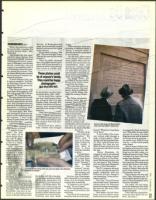
Survivors Alex Ungar and Rubin Herman
read a quote by Dwight D. Eisenhower.
he said. "Whatever we see here,
I saw there."
In the middle of the muse-
um, visitors walk through a
large portrait gallery. These
photos could be of anyone's fam-
ily. They could be happy pho-
tographs. But they are not.
Most of those pictured in the
photographs perished during
the war.
Marcy Eisenberg, 16,
stopped to talk in the portrait
gallery. She is taking a special
course at Akiva on the Holo-
caust. She has seen movies, and
she has been to Yad Vashem
and the Holocaust Memorial
Center in West Bloomfield.
The D.C. museum, she said,
is a great educational place for
people unfamiliar with the
Holocaust. For her, though it
was interesting, "it was just an-
other museum."
This time, Toby Schlussel
did not shed a tear. Sometimes
talking about the Holocaust
leaves her feeling overwhelmed.
Not this time. Her sister, Cillia
Kleiman, cried.
Their father, the late Isaac
Engel, told his children many
stories about how he repeated-
ly escaped the Nazis during the
war. Ultimately, he was caught
and sent to a camp. But Isaac
Engel survived, and he believed
the stories must be repeated —
no matter how difficult they
may be — so the Jewish people
never forget.
Like so many of these Jew-
ish people who lost their entire
families during the war, Mr.
Engel met his wife, Adela, at a
displaced person's camp. Their
courtship was short; they each
needed new families.
Mrs. Schlussel has seen all
the museums. She reads every
article she finds on the Holo-
caust. She has been to the
camps in Poland. She tells the
story of her father's history as
if it were her own life.
"This museum was very well
done," Mrs. Schlussel said. "It
was modeled similar to the mu-
seum in West Bloomfield, but it
was more detailed."
For years, she has ques-
tioned the Holocaust. How could
this happen to so many good,
religious people?
"I don't ask why anymore be-
cause we don't know the an- 31
swer," she said. El