
A bi-monthly feature in which members of the community
offer insight on topical issues.
Soul
oseph Katz lives in a
house with two harp-
sichords, a clavichord,
SPECIAL TO THE JEWISH NEWS
five clarinets, several
p wooden recorders, a
grand piano and his
wife, Fern.
At 70, the retired pharmacist
is anything but idle. His up-
stairs office is cluttered with
computer disks full of music
he's arranged, a half-repaired
clarinet, family photographs
and file drawers overflowing
SUSAN KNOPPOW
ic
with written music.
There's music everywhere —
music for clarinet, guitar,
recorder, cello, piano and voice.
Everything from modern jazz
and operettas to classical
arrangements, Yiddish folk
songs and excerpts from Shab-
bat and holiday prayers.
Mr. Katz's musical roots go
back more than 60 years, to his
days as a fourth-grade clar-
inetist at Detroit's Dwyer
School. In later years, he re-
sources and adapt it for the
recorder. Pm not too successful
at it — I'm not that great a
recorder player — but I've
arranged the music for
recorder, and I'm trying to pub-
lish it.
`There are a couple of great
clarinetists for klezmer music.
One is still alive today: Giora
Feidman. When I first heard
him, I didn't like it. I said, "He's
taken every note and screwed
it up.' But now I love his stuff.
It's his soul music. It's great.
"There's another guy who
died at the age of 90, Dave Ter-
ras. I got ahold of a record of his,
and a book that somebody pub-
lished. He played a lot of clar-
inet music. I want to publish it
for recorder.
"I've arranged a book of Yid-
dish recorder music with piano
accompaniment. It's ready to be
duplicated and played. It's
based on music from Dave Tar-
ras' book and folk songs.
"I like the use of the Yiddish
language, which I don't under-
stand too well. I like the music.
Although there is a bittersweet
theme in most Yiddish music,
it is for the most part happy. If
you listen to a klezmer band
playing, you're hearing joyful
music.
"I would like to form a band,
to get people who are really in-
terested in this, but it's not too
easy. You have to be an
arranger and a maven. If you
are both, you can collect people.
People want everything tailor-
made so they can just sit down
and play the music. So I'm try-
ing to do that.
"We had one klezmer group
that played together here. We
had two clarinets, an accordion
and two singers. A klezmer
group can be any group. It can
Why are you so committed
be one musician. Whatever in-
to klezmer music?
struments are available, that's
what you use.
"In whatever I do, Pm always
"People should stop fooling
Jewish. When you play the
around with modern music and
recorder you get involved with
get into Hebrew music and Yid-
old music. A lot of it came out
dish music. That's what I think.
of the churches — 14th, 15th,
"I played in the Jewish Cen-
16th, 17th, 18th century. It's all
ter Symphony Orchestra, but
Christian music. So I decided
they don't need a symphony or-
`Hey, I want to play klezmer
chestra — they need a Jewish
music.'
Center Klezmer Band. There's
"Klezmer music is for clarinet
a lot of Jewish music that's dy-
basically, but I've learned to
ing, and I don't think it should
play the recorder fairly well,
die. I would like to see the Jew-
and I can play Yiddish music
ish Center sponsor it. All they
on the recorder. I'm trying to
have to do is provide a place.
develop that for myself and for
Weal get musicians if there's a
others.
place for them to play."
"I steal music from other
ceived a music scholarship
to Wayne State University,
played in the army and
joined the Jewish Center
Symphony Orchestra.
At 40, Mr. Katz discov-
ered the recorder, a simple
wooden flute. Within a
couple of years he was
playing in concerts, and
soon began composing
and arranging music for
the recorder.
He even learned to
build recorders, and has
accumulated a diverse
collection that he dis-
plays in the living room
atop the family's grand
piano.
But playing and
building instruments
wasn't enough. One
evening an advertise-
ment for a computer
program that could be
used to print music
caught his eye. Ever
on the lookout for a
new musical chal-
lenge, Mr. Katz took
a one-week class and
bought the necessary
computer equip-
ment. Before he
knew it, he found
himself in the
music-publishing business.
To date, he has arranged and
published music with his
brother, pianist and composer
Bernard Katz, as well as local
cantors and other musicians.
Mr. Katz still spends a half
day every other week as a phar-
macist, but for the most part his
life is dedicated to music, par-
ticularly his newest love — the
klezmer music of Eastern
Europe.
❑
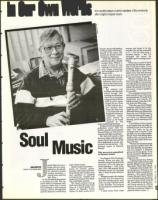
Scanned image of the page. Keyboard directions: use + to zoom in, - to zoom out, arrow keys to pan inside the viewer.
October 29, 1993 - Image 103
- Resource type:
- Text
- Publication:
- The Detroit Jewish News, 1993-10-29
Disclaimer: Computer generated plain text may have errors. Read more about this.