
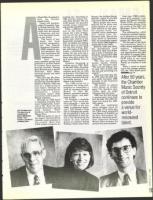
Left: The Beaux Arts
Trio takes a bow at
Orchestra Hall.
Below: CMS leaders
Zalman "Tiny"
Konikow, Lois Beznos
and Maury Okun.
s World War II peaked in
1943, the thunder
echoed locally.
Tanks and bombers
rolled off assembly lines
in Detroit factories. The
Motor City transformed
itself into the arsenal
of democracy, and race
riots fractured peace
on city streets.
The tenor of war
shook the local
artists' community,
too. The Detroit
Symphony Orchestra
(DSO) ceased its nor-
mal operations. But
area musicians did
not put down their
instruments.
formed
They
k-
small chamber groups and
gathered in private homes
to nurture their passion
through wartime. Among
those involved was a Jewish
Detroiter, Karl Haas,
renowned pianist and radio
personality.
Fifty years ago, Mr. Haas,
along with his wife Trudy,
founded the Chamber Music
Society of Detroit. CMS was
born as a small group of
local talent. Through the
years, it has evolved into an
impresario's society,
entreating talent from
around the world to play for
Detroit audiences.
Although th CMS board
is composed of people from
many backgrounds, succes-
sors to Mr. Haas are also
Jewish Detroiters, among
them Zalman "Tiny"
Konikow, Lois Beznos and
Maury Okun.
CMS has grown to one of
the largest volunteer-driven
chamber music societies in
the country. More than
3,600 names comprise its
mailing list. According to
CMS records, typical con-
certs draw between 800 and
1,000 people. Its sponsors
include major companies
and private individuals.
Today, a different type of
war on the home front
ensues. It's a time of finan-
cial woe for the arts. CMS
leaders say the Society is
faring well, relative to the
financially strapped DSO.
Still, its leaders are looking
toward ways of surviving
into the 21st century. They
are well aware of the chal-
lenges: a shrinking pool of
money for the arts and a
generation of music connois-
seurs who often prefer the
rock band Motley Crue to
Mozart.
Creative financing is
nothing new to CMS. Back
in the mid-1950s, the group
wanted to commission an
original work for its 10th
anniversary. Until that time
in America, musical pieces
had been commissioned only
by wealthy patrons, a foun-
dation or an institute.
The CMS group set a
precedent for using sub-
scriptions to commission a
work by composer Samuel
Barber. In 1956, Mr.
Barber's woodwind quintet,
Summer Music, was dedi-
cated to CMS.
Dr. Konikow — ironically
known as "Tiny" for his tow-
ering physique — took the
reins of CMS in the late
1960s. A gregarious impre-
sario, Tiny played a huge
role in changing the group.
He transformed it from one
that capitalized on local tal-
ent to one showcasing the
talent of such musical
greats as violinist Itzhak
Perlman, flutist Jean Pierre
Rampal, the Juilliard String
Quartet, cellist Yo-Yo Ma
and pianist Mischa Kottler.
Many people who know
Motown for its blues and
sports fanatics do not con-
sider Detroit an apt place
for classical music. Yet
chamber music performers
love coming here, Dr.
Konikow says. One of the
main draws is Orchestra
Hall, an acoustically superb
venue which CMS helped to
resuscitate in the 1970s.
Between 1939 and 1970,
the sporadically used
Orchestra Hall had fallen
into a state of disrepair. Dr.
Konikow represented CMS
on the "Save Orchestra Hall
Committee."
"The hall was dusty,
musty, smelly, broken
down," Dr. Konikow said.
"The roof was leaking. But
we said, 'Give us heat; stop
the rain and we'll bring in a
concert.' "
That's just what they did.
In 1978, when the Hall was
only partly renovated, CMS
brought in the Guarneri
String Quartet.
"We pulled in almost
1,000 people on broken
seats," Dr. Konikow said.
"(After that) we made
Orchestra Hall our home."
CMS was the first group
to permanently move back
into the hall. The DSO fol-
lowed suit during the 1990-
1991 season.
CMS has undergone
many changes since its
inception. Five years ago,
the CMS board appointed
Lois Beznos of Franklin as
its first chairwoman. Dr.
Konikow remained presi-
dent. Executive Director
Maury Okun became the
group's first paid employee.
Last year, CMS collabo-
rated with another local
group, the Detroit Chamber
Winds (DCW), an ensemble
of musicians drawn from
the ranks of the DSO and
Michigan Opera Theatre
Orchestra.
The collaboration, which
minimizes overhead expens-
es, is attractive to corporate
and private sponsors of both
groups, Mr. Okun said.
"On the part of the fund-
ing community, there's a
really strong predilection to
support collaborative
efforts," he said. "People
and organizations that have
the ability to support differ-
ent groups like CMS and
DCW want to see these
groups working together.
There's an economy of scale
here."
When it comes to appeal-
ing to the younger genera-
tion, Mr. Okun draws paral-
CRESENDO page 114
After 50 years,
the Chamber
Music Society
of Detroit
continues to
provide
a venue for
world-
renowned
talent.
Scanned image of the page. Keyboard directions: use + to zoom in, - to zoom out, arrow keys to pan inside the viewer.
August 27, 1993 - Image 113
- Resource type:
- Text
- Publication:
- The Detroit Jewish News, 1993-08-27
Disclaimer: Computer generated plain text may have errors. Read more about this.