
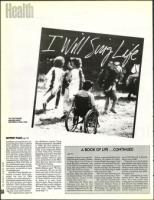

Two Yale University
graduates wanted
sick children to have a voice.
HAPPIEST PLACE page 103
members are sensitive to un-
usual dangers that confront
their campers. Chemothera-
py patients are more prone to
skin cancer, so they are care-
fully monitored during out-
door activities. Juice stations,
to avoid cases of dehydration,
dot the area. Campers are
transported on field trips, for
example to New York City, in
air-conditioned buses. An am-
bulance and medical airlift
are easily accessible in case
of emergencies.
Another Camp Simcha op-
erates in Israel. Both cam-
puses are run by Chai
Lifeline, an international or-
ganization dedicated to help-
ing sick children and their
families. Chai Lifeline offers
year-round support services,
emergency funding, counsel-
ing and crisis intervention.
The organization pays for
the children's entire Camp
Simcha experience. Founded
in 1986, the Chai Lifeline is
supported by private dona-
tions. It has regional offices
in New York City, Florida,
England and Israel. Founder
Rabbi Simcha Scholar ex-
pects another office to open
soon, somewhere in the Mid-
west. But now, there's a need
for further funding.
"We need a lot of money,"
Rabbi Scholar said. "We live
on a miracle. We are at the
beck and call of the Jewish
community because we nev-
er turn down children. Some
of these children aren't going
to make it to next year.
They're kids. They're Jewish
kids and they're sick children.
We have to help them. They
need help. Their families
need help." ❑
A BOOK OF LIFE ...CONTINUED
page 103
category of grief and anguish.
Both are most certainly present
in large doses, but for me at
least, the force of the book...has
to do with the strengthening of
hope, the compression of wis-
dom," Mr. Newman writes.
One of the seven children in
the book, Adam Jed, talks about
his dream of being "the richest,
most famous lawyer in the
world when I grow up."
Eight-year-old Adam also
discusses the day he was
rushed to the hospital for what
was later diagnosed as DIC, dis-
seminated intravascular coag-
ulation, a rare and deadly blood
disease. He relates in frank,
boyish English his anger at his
parents, who allowed the life-
saving amputations of his
hands and legs. He discusses
what it's like learning to walk
with prosthetic legs:
"My first steps were fun, but
it still seemed very hard...Now,
I jump; Heap; I gallop," he says.
Ms. Lithwick, who this sum-
mer worked as an intern at the
Children's Defense Fund, a
child advocacy organization in
Washington, D.C., explains why
she and Mr. Berger chose to
have / Will Sing Life in the chil-
dren's own words:
"Virtually every book about
sick children has been written
by healthy adults...but I think
when you ask a sick child to tell
another sick child what's im-
portant, something very differ-
ent comes out.
"Kids understand in ways
adults don't," Ms. Lithwick
says. "In a way, you're very
young and very old when you're
sick. They're very weirdly wise.
Speaking for children is such a
mistake because they speak so
well for themselves." 0